 Accommodation | International
Flights | Domestic
Flights | Tours
| Travel
Insurance | Car
Hire | Visas
| Shopping
| Dating
| Humour
Accommodation | International
Flights | Domestic
Flights | Tours
| Travel
Insurance | Car
Hire | Visas
| Shopping
| Dating
| Humour
Amazing Australian Artists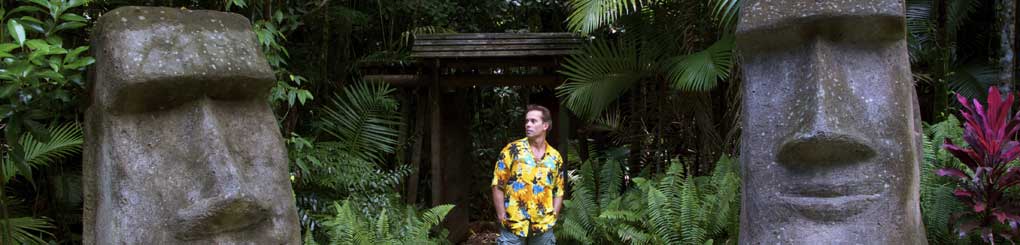
Rob Lapaer and some of his ginormous concrete sculptures
Australia has some pretty amazing artists, below is a small selection but you are welcome to contact us if you know of, or are, an artist that we can add to this page.
Albert Namatjira
Albert Namatjira was the first Australian Aborigine to be
recognized both nationally and internationally as an artist. He is now
one of Australia's best-known artists. His landscape paintings capture
the essence of the Australian outback. Namatjira's paintings express his
relationship with the Arrernte country, particularly the Western Arrernte
lands, for which he was a traditional custodian. Through his intense scrutiny
of specific places and his sensitive response to their individual qualities,
Namatjira enables us to see the Centre as a multi-faceted region of Australia.
A region of extremes, central Australia is far from a 'dead heart'.
Albert Namatjira was born in 1902 spending time in his early formative
years at the Hermannsburg Lutheran Mission. He was initiated as a young
man into the sacred tribal ways and was taught the tribal customs and
ancient laws of the Western Aranda. Namatjira greatly respected his tribal
laws and seldom traveled far from his ancestral home. The majority of
his watercolour works were landscapes of areas that he had known throughout
his life, for they fell within the tribal land of the Western Aranda.
Namatjira‘s works captured the vibrant colours of the Western MacDonnell
Ranges in the north and the Krichauff Ranges to the south. They also captured
the crater-like mountain mass of the circular Gosse's Range to the west,
the tributaries of Ellery Creek and Hugh River to the east, and in many
works the broad bed of the Finke River that ran through the heart of his
tribal land. He also painted the mauve hues of Mount Sonder, the white
ghost gums against Glen Helen's red escarpments and the blue waterholes
of the Ormiston.
Nearly all of his works were painted 'plein air' (on site) rather than
from memory and they were mostly painted in the winter or dry season.
Most of his works were landscapes, some in which he included the native
wildlife, and occasionally he painted a portrait of one of the Central
Australian tribesmen.
His art brought him fame and a degree of wealth, but little freedom. Throughout
his life he never neglected his tribal responsibilities and he never neglected
his family or his people, sharing the little that he made from the sales
of his art, with his family and friends.
Albert Namatjira died in 1959.
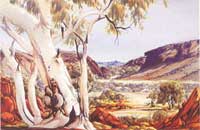
Heavitree Gap, Alice Springs
Buy at Picturestore.com.au
Arthur Boyd
Born in Murrumbeena, Victoria on July 24th, 1920 into a
family of long famous artists, he held his first exhibition at the age
of 17 in Melbourne.
After a few years of service in the army during World War Two ran a pottery
until he finally started painting full time in 1949 and established an
international reputation.
His works, such as Wimmera Landscape and The Blind Nebuchadnezzar With
Lion, can be found in every state gallery around Australia, the Victoria
and Albert Museum in London and the Mertz Collection in America.
He suffered a heart attack in Sydney in February, 1999, and died at the
age of 78, on 24th April, 1999, in Melbourne.
He donated the Arthur and Yvonne Boyd Education Centre at Bundanon on
the NSW South Coast to the people of Australia in 1993, valued at over
$20 million. He also left over 2000 art works to the National Gallery
and was declared Australian of the Year in 1995.
|
|
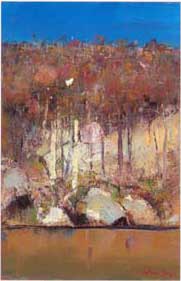

Arthur Streeton
Arthur Streeton, the fourth of seven children, was born
at Duneed, near Geelong, Victoria on the 8 April 1867. From Christmas
1888 to mid 1890, he lived on the Mount Eagle estate.
In August 1889, Streeton exhibited 40 works in the 9 x 5 Impression Exhibition.
He traveled to London in 1907 where he married. He returned to Australia
and in 1921 purchased a property in Olinda, which he called ‘Longacres’
and built his home.
In 1937, Streeton was knighted for his services to art. His friends knew
him as ‘Smike’ (from Dickens’ novel Nicholas Nickleby)
allegedly because of his slight physique.
Sir Arthur Streeton died on 1 September 1943 and is buried in Ferntree
Gully Cemetery.
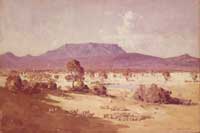
Land of the Golden Fleece
Buy at Picturestore.com.au
Brett Whiteley
Brett Whiteley was born in 1939 and studied at the Julian
Ashton School in 1957-59. In 1960 an Italian scholarship took him to London
where his great natural talent for drawing, his lack of inhibitions and
taste for exotic influences made the 21 year old painter an exciting prospect
for London dealers. His work was shown at the Whitechapel and Marlborough
Galleries from 1961 and in that year he was selected to represent his
country at the 'young Painters' Convention' UNESCO, Paris. Even more crucial
to Whiteley’s future was his success in winning the International
prize at the second ‘Biennale de Paris' (International Biennale
for Young Artists), which brought with it the excitement, glamour and
disadvantages of world publicity.
In 1961 he returned to Australia where he held several exhibitions, also
traveling to the USA several Asian countries. What he learned from his
contacts with such countries as Cambodia, Vietnam and Japan is expressed
in his drawings and paintings, and even more in sculptures such as 'Asia',
a construction in fur, steel and acrylic in which a white Wallaby was
depicted with its head stuck in a sewerage pipe. During 1979 he won a
number of national prizes and settled at lavender Bay, Sydney.
Whiteley symbolised his irrational obsession with the colours blue and
gold in much of his work. The whole pattern of Whiteley's life was written
into his drawings and paintings with scintillating brilliance. Brett Whiteley
died in 1992.
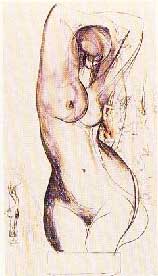
Nude Study for Large Wood Carving
Buy this at Picturestore.com.au
Bruno Torfs
Bruno Torfs was born in South America but moved to Europe and then on
to Australia where he set up home in Marysville.
He found the luscious sub-alpine forests here the perfect place to build
a sculpture garden, originally it opened with only 15 sculptures but it
expanded in to more than 200 and Bruno is still making regular additions.
The unique experience of the garden and its wondrous inhabitants attract
many visitors each year. Bruno and the family still live there and always
take great pleasure in being able to share their magnificent art treasure
with all that come.
Unfortunately in the 2009 bushfires the forest and many sculptures were
destroyed but many of Bruno's friends got together to help restore the
gardens and the gardens have been re-opened. More
info on his website.
Fred Williams
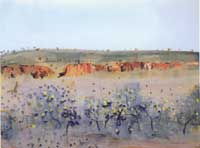
Hardy River, Mount Turner Syncline
Buy at Picturestore.com.au
Jeffrey Smart
Jeffrey Smart was born in Adelaide in 1921 and studied at the SA School of Arts and Crafts., in Europe from 1948 including a period under Fernand Leger at the Academie Montmartre. Returning to Australian in 1951 he became art critic fro the Sydney Daily Telegraph and a broadcaster for the ABC. In 1963 he settled in Italy and has lived in Rome and Tuscany for most of the past 30 years. A major retrospective was mounted at the Art Gallery of NSW in 1999
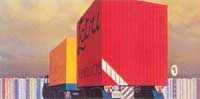
Truck and Trailer Approaching a City
Buy at Picturestore.com.au
Ken Done
Most financially succesful Australian artist who did not have to die first for his work to sell like often seems to be the story. His cheerful designs are found on many products such as clothing, teatowels, cushions etc. and very popular with Japanese tourists.
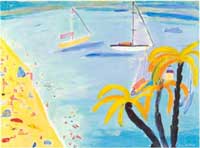
Chinamans Beach III
Buy at Picturestore.com.au
Rob Lapaer
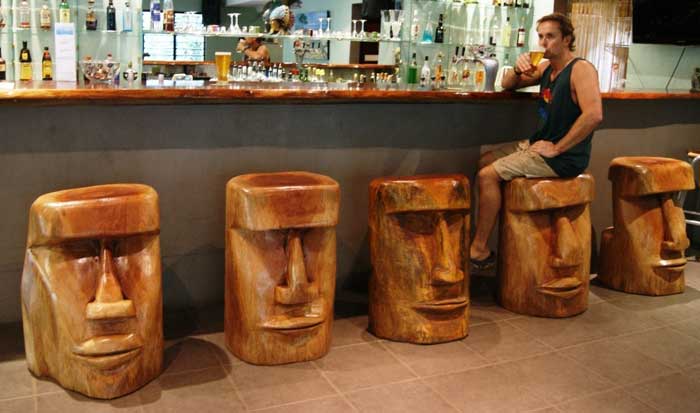
Rob resting on one of his massive timber barstools
Born in Holland in the famous cheese town of Gouda, he is
now settled in northern Australia's Daintree rainforest where he runs
his bed and breakfast Rainforest Hideaway, and creates his sculptures,
which are usually large, involve chainsaws and tonnes of conrete, and
are often built on site and will not go anywhere for centuries.
He likes the idea that one day when this civilization has managed to wipe
itself out archeologists will wonder about these art forms, and perhaps
find the time capsules inside them and open them.
You can see more of Rob's concrete sculpture on his sculpture
trail and see his Moai bar
stools for sale
Russell Drysdale
Born in Bognor Regis, England in 1912 Drysdale lived in
Australia from 1923. He studied with George Bell in Melbourne, at the
Grosvenor School in London and at the Grande Chaumiere in Paris. He exhibited
widely in Australia and overseas and his outback landscape works came
to symbolize the real Australia. Retrospectives were mounted by the Art
Gallery of NSW and the National Gallery of Victoria. In 1954 he represented
Australia with Sidney Noland and Dobell at the Venice Biennale. He was
appointed a Trustee of the Art Gallery of NSW in 1963 and in 1969 was
knighted for his services to Australian art.

The Cricketers
Buy this at Picturestore.com.au
Sidney Nolan
Sidney Nolan was born in Melbourne on 22 April 1917. He
studied intermittently at the National Gallery Art School, Melbourne,
from 1934, and engraving and lithography under S.W.Hayter at the Atelier
17, Paris in 1957.
During the Second World War, Nolan was conscripted into the army and served
at Dimboola in the Wimmera District of Victoria 1942-1945. In 1946 he
began a series of paintings on the theme of the bush ranger Ned Kelly,
and later painted personal interpretations of historical and legendary
figures such as Eliza Fraser and Burke and Wills, in which he expressed
the feeling of the country and the timelessness of the myths. Nolan also
painted a series of works portraying Central Australia.
From 1950 Nolan lived mainly in Britain and became Australia's most internationally
celebrated painter. He also designed sets for ballet and opera and provided
illustrations for books. He died in London on 28 November 1992, aged 75.
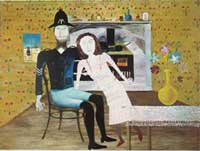
Constable Fitzpatrick with Kate Kelly 1946
Buy at Picturestore.com.au
Tim Patch
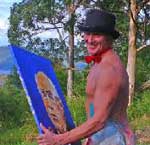
A penis portrait of John Howard
Image from Tim Patch's website Penileart.com
Queensland artist Tim Patch is not your average artist,
instead of going to the shop to buy paint brushes he simply uses his penis
as a paint brush! Check out his website Penileart.com for more of this
amazing art.
His father was shocked when he first found out on the news about his son's
talents, though Tim's girlfriend was more enthusiastic about it. Tim's
big breakthrough was when he sent two paintings of John Howard and Kim
Beazley to the Sexpo in Perth where 35000 people appreciated his work.
Tom Roberts
Tom Roberts, painter and photographer, was born on 8 March 1856 at Dorchester, Dorset, England. He arrived in Geelong on 22 June 1869 and settled in Collingwood. In his early years Roberts was encouraged to paint plein-air by Louis Buvelot and his interest in plein-air painting was further stimulated by a study tour of Europe between 1881 and 1885. In 1889, he exhibited 62 works in the 9 x 5 Impression Exhibition.
In 1896 Roberts married and in 1903 the couple travelled to London. They returned in 1923 and settled at ‘Talisman’, their small cottage on half an acre, in Kallista.
Tom Roberts, who was known as ‘Bulldog’ to his friends due to his tenacious personality.
He died at ‘Talisman’ on 14 September 1931, and his ashes are buried in the Illawarra churchyard, near Longford, Tasmania.
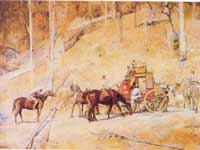
Bailed Up, 1895-1927
Buy at Picturestore.com.au



HOME PAGE
Tourist Information
General Information
And Entertainment
ACCOMMODATION IN AUSTRALIA
Bed
& Breakfast
Budget
Accommodation
Backpackers Hostels
Hotels
in Australia
CAR HIRE IN AUSTRALIA
Australia Rental Cars
And
Campervans


TOURS
IN AUSTRALIA
What To Do In Australia
On-line
Shopping
On-line
Dating

About
Australia
Visas For Australia
How
To Get To Australia
How To Get Around
Travel Insurance
Travel Guides
Working
In Australia
Australian
Posters
Survival
Tips
Weather,
When To Go

Use of
this website constitutes acceptance of the User Agreement for this website
Contact us |
Advertise on this site
| Link to this site |Add
your photos or stories to this site |
Webmasters | Affiliates