 Accommodation | International
Flights | Domestic
Flights | Tours
| Travel
Insurance | Car
Hire | Visas
| Shopping
| Dating
| Humour
Accommodation | International
Flights | Domestic
Flights | Tours
| Travel
Insurance | Car
Hire | Visas
| Shopping
| Dating
| Humour
Box Jellyfish
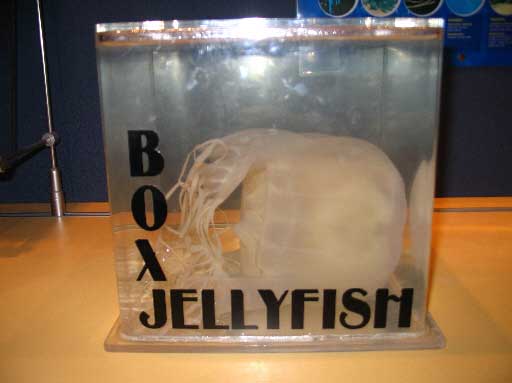
Photo by Katrin Holmsten
Box Jelly Fish
Australia's box jelly fish, also known as sea wasp
or stinger, is claimed to be the world's most venomous marine animal
known, over the last century they have killed about 60 people in
Australia.
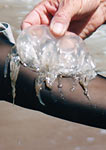
The Box Jellyfish has a four sided shape up to 20 cm long and they
may have up to as many as sixty tentacles up to 3 metres in length.
Their color is pale blue and transparent and they are difficult
to see, and for a long time it was a mystery what was actually causing
such excruciating pain often followed by death, which can occur
sometimes within 2 to 3 minutes.
They do not actually attack people, they will even try to get away
from people but sometimes people just bump into them. People have
even been stung by dried tentacles in fishing nets, even a year
in the garage does not reduce the effects of the toxin!
It is a myth that this dangerous jelly fish only lives
in Australia, they are also found through south east Asia, but there
statistics are not kept, and there is no coordinated defence and
warning system against them like in Australia. According to Surf
Lifesavers national marine stinger adviser Lisa-Ann Gershwin around
90 people a year die in the Phillipines from this jelly fish, and
tourists have died in Thailand too, with doctors and authorities
trying to cover it up as drug overdose.
Australia is the only country where people are warned with signs
not to swim, in other countries it is probably the tourism industry
that does not want to scare people off, but if you are going to
get stung you are better off having it done in Australia where the
hospitals know how to treat you than in some Asian country where
they don't!
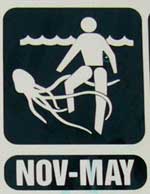
Box Jellyfish Season
The Box Jellyfish season across the top of northern Australia
starts around October and lasts until April or May. Further
south along the northern Queensland or northern Western Australian
coast the season is usually from November to March though
in Darwin they have been spotted even in the dry season. They
sometimes appear further south and sometimes a few weeks beyond
the official close of season before disappearing until the
next wet season. |
 |
Where they live
Box Jellyfish hunt small crustaceans and small fish. They travel towards the shore in calm weather on a rising tide and congregate near the mouths of creeks and rivers following rain when food is washed down these watercourses to the waiting Box Jellyfish.
Fortunately they only live close to shore so you can still go out to the Great Barrier Reef which is too far offshore for them.
For mobility, the Box Jellyfish contracts with a jet-like motion, shooting itself along up to speeds of 4 knots. It is presumed to have eyes connected to a nerve ring and the creature can take evasive action or move towards its prey.
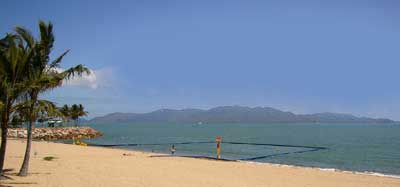
A stinger net at a Townsville beach
Most towns in northern Australia will have a stinger net installed to allow people a relatively safe swim in the ocean to cool down, although they keep box jelly fish out the Irukandji, Bluebottles and other small jelly fish can still get through the net. The nets also have to be managed, checked and maintained as sometimes crocodiles have been found in the nets!
The Box Jellyfish uses its tentacles to kill its prey. If a swimmer makes contact with the Box Jellyfish's tentacles, perhaps only 6 or 7 metres of them, death may result! Children may die after even less contact. The severity of the sting is relative to the size of the Box Jellyfish, the sensitivity of the victim's skin, and the amount of tentacle that has come into contact.
A very large Box Jellyfish has tentacles that, if placed end to end, would measure more than 60 metres, so it is not unusual for a rescuer to inadvertently become entangled in another section of the tentacles and suffer the same fate. Sometimes the victim somehow manages to get ashore only to die within a few minutes.
First Aid
First Aid you can try in a situation like this includes washing
the affected areas with vinegar (often bottles are placed on stands
along northern beaches) and mouth to mouth resuscitation and CPR
if the victim becomes unconscious as the toxin paralyzes the muscles
that normally control breathing and heart beat.
Do not rub the stings as more tentacles may fire off, just pour
on the vinegar that will stop any unfired tentacles from doing more
damage. Remember the emergency phone number is 000 in Australia.
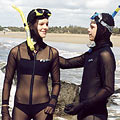
Of course it is better to not get stung in the first place and to wear a stinger suit, on Stingersuits.com you can read all about this Australian invention and see where they are for sale.
 |
 |

HOME PAGE
Tourist Information
General Information
And Entertainment
ACCOMMODATION IN AUSTRALIA
Bed
& Breakfast
Budget
Accommodation
Backpackers Hostels
Hotels
in Australia
CAR HIRE IN AUSTRALIA
Australia Rental Cars
And
Campervans


TOURS
IN AUSTRALIA
What To Do In Australia
On-line
Shopping
On-line
Dating

About
Australia
Visas For Australia
How
To Get To Australia
How To Get Around
Travel Insurance
Travel Guides
Working
In Australia
Australian
Posters
Survival
Tips
Weather,
When To Go

Use of
this website constitutes acceptance of the User Agreement for this website
Contact us |
Advertise on this site
| Link to this site |Add
your photos or stories to this site |
Webmasters | Affiliates