 Accommodation | International
Flights | Domestic
Flights | Tours
| Travel
Insurance | Car
Hire | Visas
| Shopping
| Dating
| Humour
Accommodation | International
Flights | Domestic
Flights | Tours
| Travel
Insurance | Car
Hire | Visas
| Shopping
| Dating
| Humour
Survival tips for Australia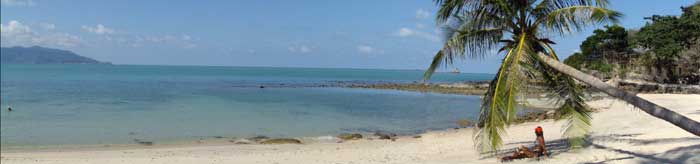
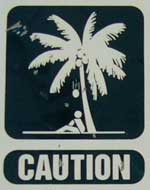
Survival tip: don't sit under coconut trees
The National Emergency Phone Number in Australia (free call):
000
On the road
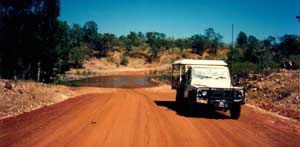
Drive on the left hand side of the road.
In outback areas on unsealed roads it is common to drive on whatever side
of the road is in the best condition but take great care in bends and
crossings with other roads as other road users may not expect you there.
In far north Queensland there have been quite a few crashes with Europeans
forgetting that Australia drives on the left, wrist bands were issued
by authorities as gentle reminders for drivers.
Also keep the car facing forward, driving it sideways increases wear on
the tyres:
Bottle shops. When planning to head out bush and do some camping in remote areas plan ahead with your alcohol supplies, you might find that the only bottleshop in town ( and the next town 500 kms down the road) is closed because it is social security pay day, and authorities try to get the local population to spend some money on food for the kids before spending it at the pub. Argueing with the bottle shop staff that you are a tourist will not get you anywhere, rules are rules.
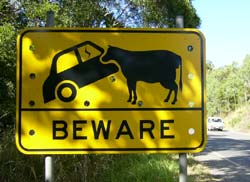
Do not drive at night in outback areas.
A lot of cattle stations are not fenced and cows often wander around or
sit on the roads at night and the darker ones are very hard to see. Also
kangaroos are a hazard as they will freeze in position when your
headlights shine in their eyes or even when they are next to the road
they will try to flee from the noise of your car and will jump where they
can most easily see where they are going, which is in the lights in front
of your car!
And if you don't have some bars up the front then you can start singing
"see you later, radiator!"
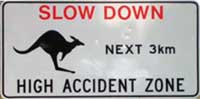
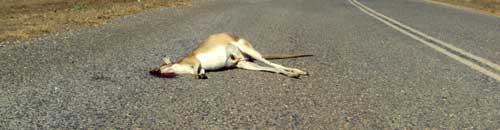
See you later radiator.......
If your car is equipped with bars on the front, do not
expect too much, the cheap and light ones will just fold away, some heavier
ones may just protect your radiator so you can make it to the next town
but will still crumple the front
of your car and only the heavy duty ones on a large four wheel drive
may, at not too high speed, get you through it without a repair bill.
Though they are often called "bull bars" it would definitely
not be a good idea to actually hit a real bull with them.
When passing through outback towns at night you may encounter people under
the influence of alcohol on the road, in February 2004 a Katherine police
car on patrol ran over a man and killed him.
Stay with the vehicle. Over the years numerous people have died trying to walk back to civilization after their car got stuck or had broken down. Search and rescue planes can easily spot a car from the air but a person is much harder to see. About 100 km down the track from the Queensland outback town of Birdsville is a memorial to the Page family who tried to walk out, after their car had broken down in 1963. All five members of the family died. This is only one example, there have been many more since then.
Drive wisely. Just because the Northern Territory does not have speedlimits or there is no police to be seen is no reason to do 180 km/h, animals do cross the road from time to time. Also beware of the wedge tailed eagles, these are eagles with wing spans of a couple of up to two metres and they feed on road kills on outback roads. If you approach too fast they may not have time to fly off and end up coming through your windscreen. Often accidents are due to tyre blowouts too, make sure your tyres are up to the long journey, tyres in remote areas are remarkably more expensive than in the city. Take rest stops, many accidents are due to tired drivers. Although the coffee at outback roadhouses is often of a shocking quality you may have to drink some to help you stay alert. Look at your speedo when you pull into a petrol station, after doing 130km/h for a few hours you may feel like you're doing walkingpace coming into the petrol station when you're still doing 70km/h. Title Max wants drivers to be safe on any road they travel. Excessive speed is the main cause of most serious accidents, so drivers should heed the advice whether they have a Title Max title loan on their vehicle or not.

If you're on narrow roads or dirtroads pull over if you see a roadtrain, their hundred or so wheels throw up a lot of rocks so you want to stay away as far as you can from that. It is a good idea to keep your headlights on on dusty roads, it makes your vehicle much easier to spot in the clouds of dust that get thrown up.
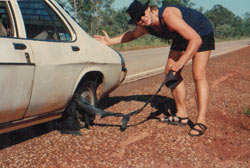
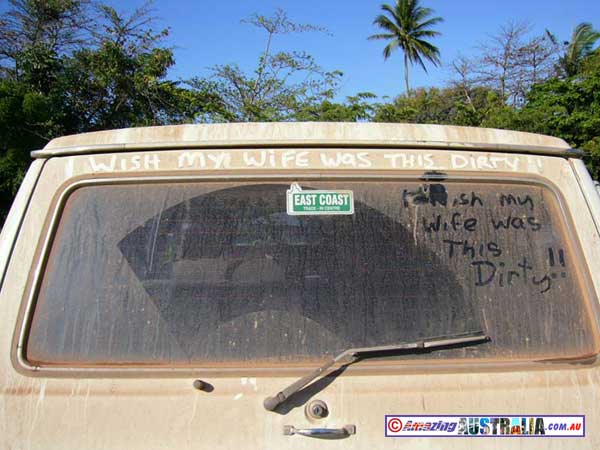
Photo by Rob Lapaer of Rainforest
Hideaway B&B, Cape Tribulation, N.Qld.
Grey nomads are a seasonal hazard, usually migrating in a northerly direction in winter and back south again in summer. The term refers to retired people that travel around the country, some endlessly as they sold the house to pay for their caravan or mobile home with absolutely every modern convenience ever invented, and often travel at speeds of max. 70km/h unaware of traffic banking up behind them as the caravan is too wide for the mirrors to be of any use. This often leads to people overtaking in dangerous situations.
Four wheel drives. If you are renting a
four wheel drive to go and do some exploration remember that, apart from
some modern continuous all wheel drive vehicles, often the four wheels
d not actually get driven until you get out and engage the hubs on the
front wheels, the gear stick inside the vehicle is only half the job.
If you drive on soft sand lower the tyre pressure; it is amazing how much
difference it makes when you think there is no way you can get out if
this place and you let some air out of the tyres. A few years ago a tourist
got his 4WD stuck in Lake Eyre in South Australia, he decided to walk
to get help ( first mistake; stay with the car) and died when he ran out
of water. A companion that stayed with the car survived and when rescuers
arrived they let some air out of the tyres and drove the vehicle out!
When driving in a four wheel drive remember the centre of gravity is higher in this type of vehicle, single vehicle roll overs where there are no other cars around and the driver just lost control are common. If your vehicle has a roof rack do not put too much weight on it as it will make the vehicle top heavy and more likely to roll over.
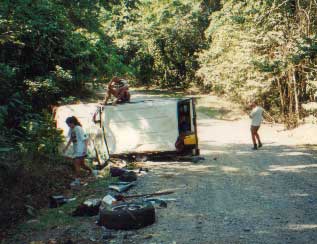
Photo by Rob Lapaer of Rainforest
Hideaway B&B, Cape Tribulation, N.Qld.
Dry areas. Some Aboriginal reserves and large areas up Cape York have been declared dry areas, meaning you can not take any alcohol in there or have in your possession. Tourists have been fined thousands of dollars for having alcohol with them on their holidays, if you're heading this way ring 1300 789 000 for up to date info on restricted areas.
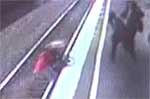
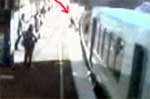
On the train. When you take the train in Melbourne hang on to your baby's pram at all times. Within a space of a few months no less than two babies in prams managed to drive off Melbourne railway platforms, but both survived without major injuries despite falling on the tracks and being dragged along by the trains. Actually, come to think of it, there is no need to worry about your baby falling in front of Melbourne trains because statistically speaking they currently have a 100% chance of surviving anyway!
|
|
In the sun
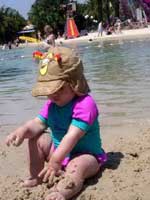
This is how Aussie kids enjoy the beach.
Photo by Jodie OBrien
In the sun. Australia, and particularly
the state of Queensland, has the highest rate of skincancers in the world!
Melanoma, the nastiest type of skin cancer, kills hundreds of Aussies
every year. Many tourists think they will be OK as they are only here
for a short time and their holiday will not be succesful if they do not
return home with a sensational suntan to make all their friends and colleagues
jealous but they really should protect themselves from the sun. Remember
the sunshine in Australia is not the same as in Europe, due to a hole
in the ozone layer that hangs over Australia and New Zealand ( even on
a chilly day in Auckland or Melbourne you can get a serious sun burn).
So use your hat, sunscreen and sunglasses.
The World Meteorological Organisation measures the hole in the ozone layer
every year that hangs over Antarctica and reaches out over Australia,
in 2005 it measured 27 million square km.


In the bush
When lost in a hot place take it easy,
find some shade, preserve your energy and water. An example is the German
tourist that became separated from the tour group in the Olgas near Ayers
Rock. He panicked straight away , started running around in the heat that
was in the 40s that day and when found, only an hour later, had already
died from heat exhaustion. Had he sat down in the shade he probably would
have been OK for several days to wait for searchers.
Coconuts can be a great drink when you're thirsty, and easy to get in
to with the cocotap, buy one of those gadgets as they will get you a refreshing
drink and do lots of other stuff.
It is a good habit to keep an eye on the sun at the start of your walk
and throughout it. Remember the sun is in the EAST in the morning, NORTH
at midday, then moves further anti-clock wise until it sets in the WEST.
This is the opposite direction of the Northern hemsiphere where the sun
goes clockwise and sits in the SOUTH at midday. If you lose the walking
track navigating by the sun can help you find your way back again.
When you're camping it is also not a bad idea to give your boots a shake
in the morning before putting them on your feet, something might have
made itself at home in there through the night.
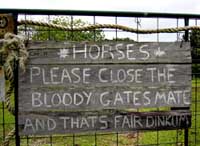
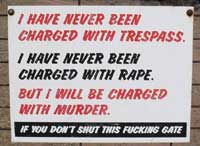
You may encounter gates on the roads you travel, the etiquette is to leave
gates as you found them, close them after you if they were closed, and
leave them open if you found them open.
 |
 |
Tell someone your plans. It is a good idea when you set off on a bushwalk or boat trip to tell someone your plans and your estimated time of return so they can raise the alarm if you do not return. Of course it is also very important to tell same people again that you have returned, it has happened many times that time and resources were wasted looking for people that had safely returned but not bothered to inform people of this.
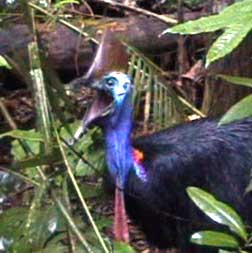
Cassowaries like to chase people so if you come face to face with one do not turn your back and run, this will encourage him to chase you and you can run for miles, the bird can do 50km/h so you are not going to outrun him anyway. Back off slowly, hold something in front of you, go behind a tree or raise your arms up to look taller.
Coconuts can keep you alive for a long time, when a boat sank in the Torres Strait some kids survived by swimming a great distance to an island with one coconut tree where they drank coconuts until they were rescued a week later. It can be hard work getting in to a coconut but with the Cocotap life becomes a lot easier, the Cocotap website will also teach you how to climb those coconut trees..
On the toilet
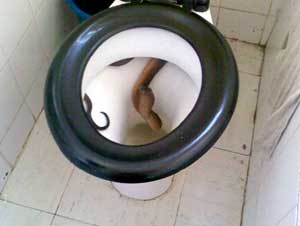
Even when the toilet door is not locked, the toilet may still be occupied. Not by a person, but by a frog, spider, or snake...
In the water
Jumping and diving off cliffs is a common
way to end up with serious injuries or even die, each year around Australia
lots of people end up hurting themselves this way, including myself who
fractured a vertebrea in the Kimberleys and had to wait two days to get
to Broome hospital. The advice is; DON'T !!
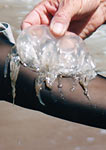
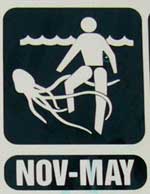
Animals in northern parts of Australia can be nasty and
there are box jelly
fish from about end October till May. They can kill you within
minutes so it is wise to look for the stinger nets that local councils
provide at their beaches or if none are present find a swimming pool or
creek. If you do get stung the best first aid is to pour stung area with
vinegar ( often found supplied at northern beaches) and if victim loses
consciousness mouth to mouth resuscitation and CPR as the toxins paralyze
the muscles for breathing and heart beat. Of course it is better to not
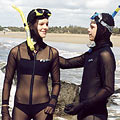
get stung in the first place and to wear a stinger suit, on Stingersuits.com
you can read all about this Australian invention and see where they are
for sale.
 |
 |
 |
If you do choose a river or lake to swim ( in the north)
check with locals that there are no saltwater
crocodiles as this could also ruin your day.
Coral should not be touched or stood on. One reason is
that coral is a living organism made of tiny polyps that you kill by crushing
them, another one is that if you scratch yourself on coral it can give
nasty infections.
When swimming in the ocean anywhere around Australia
stick to the beaches patrolled by life savers if you are not confident
in judging the situation, many parts of the coast have undertows that
can drag you out to sea. Lifesavers place red and yellow flags to indicate
the area they monitor and will close the area if they consider the area
unsafe because of undertows, jellyfish, crocodiles or sharks. There are
nearly 300 lifesaving clubs around this country that rescue 12000 people
a year and in February 2004 as many as 200 people in one day had to be
rescued on the Perth beaches.
Riptides or undertows can unexpectedly drag you out to
sea, the best thing to do if you find you cna not get back is not to fight
it and exhaust yourself but try to get the attention of lifeguards or
people on the beach by waving. Even if nobody sees you it is still better
to float out a bit on the current and to swim back a bit further up or
down the beach where there is no current.
Sharks tend to go for blood so one survival technique
by scuba divers is to always dive with a buddy and always have a knife
with you. Then if you see a large shark approaching you take the knife,
stab your buddy so he starts bleeding profusely and rush back to the boat
for a beer to calm the nerves while the shark feasts on your buddy.
This was actually meant as a joke so please don't tell the judge that
we told you to do this, but in 2005 several people survived shark attacks
simply by punching the shark in the head, so this is a recommended survival
tactic.
Sting rays often lie hidden under sand in the shallows
on the waters edge, it is best practise to either splash and make plenty
of noise or shuffle your feet so you don't actually step on top of them
as this will cause them to whip the end of their tail around and stab
you with a sharp barb which usually stays behind in the wound and is extremely
painful, and you don't want to end up like Steve Irwin!.
Crcodiles come in two varieties; the 'salties' will eat
you and the 'freshies' are harmless and usually OK to swim with so see
what type of crocodile is in the water where you plan to swim first.The
most easily noticed difference between the two is the shape of the head
and teeth.
- Freshwater crocodiles have longer and thinner snouts, with a straight
jawline, and all their teeth nearly equal in size, also they do not grow
longer than a maximum of three metres.
- Saltwater crocodiles have a broad, powerful-looking snout, with an uneven
jawline. Their teeth vary in size with some almost twice the size of others.
Theiir overall body size can be up to seven metres.
Salt water crocodiles hate getting their eyes poked so
when the croc has got you in his jaws just reach out and scratch his eyes
and he will let go. They also do not have much muscle to open their mouths
( but a lot to close it) so if you wrap your arms around his mouth you
can stop him from biting, which is a good idea as, due to the crocs not
brushing their teeth too often, bacteria from their mouth tends to infect
the wounds that bad that even after the skin has already healed there
is still infection underneath and the doctors might have to cut you open
again to treat this. Then get out of the water ASAP and start filling
out the travel insurance claim form and negotiate a lucrative deal with
a TV station, in recent years it has become more common for the media
to pay people for exclusive rights to their story so don't give it away
too cheap. If you are being chased by a crocodile run in a zig-zag pattern,
crocs can outrun a horse on a short distance but only in a straight line.
It might also help to keep a bag of mussels with you as an Aboriginal
woman in 2003 managed to fight off a croc by hitting it with this and
lived to tell the tale.
One traditional way of 'testing the water' in Australia
is to send in the dog first. If he is still there by the time you finish
your first beer then it is probably OK. This technique is not recommended
and also impractical as many overseas visitors do not have their dogs
with them. Maybe if you are staying with friends or relatives in Australia
you can borrow their dog.
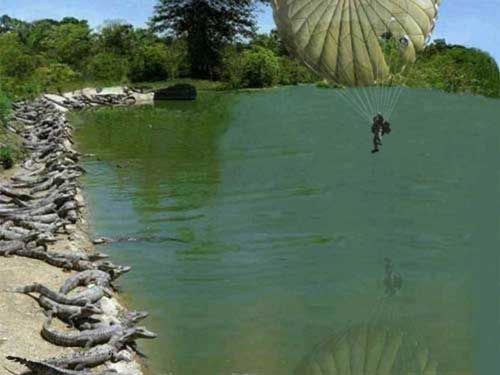
It is advisable to check the map for crocodile farms before you go parachuting.
In the pub
Feel free to call the Queen whatever you like but when surrounded
by real Aussies do not tell them the Aussie beer is crap or say anything
negative about Don Bradman unless you have a very good travel insurance
or have held a black belt in karate for some time. If there is a big sporting
event on the screen in the pub where you are make sure you know which
team is the favourite of the locals and do not cheer too loud when it
gets trashed by the other team.
If you're in a bar that employs bouncers do not presume they are there
out of concern for your safety, it is not uncommon for bored bouncers
to get stuck into (drunk) customers if there are no real trouble makers,
avoid any arguments with them.
Americans: If you're an American traveling in Australia you will find it a pretty safe country where you are unlikely to get kidnapped, tortured, shot, or blown up and have your corpse dragged through the streets like in some Middle Eastern countries. But should you want to avoid any chance of political discussion you can disguise yourself as a Canadian with a special kit from T-shirtking.com. For U$24.95 you get a complete disguise. A T-shirt with the Canadian flag and the saying "O Canada! (National Anthem), a patch for your luggage or backpack, a window sticker and a lapel pin. Plus - Free Report - How to Speak Canadian, Eh?!
French: most Australians have short memories so the nuclear bombs in the ocean to our east and the blowing up of the Greenpeace Rainbow Warrior in our Kiwi neighbour's harbour are now forgotten and you should be pretty safe.
If you don't want to stand out as a tourist avoid drinking Foster's beer, stick to VB, or XXXX in Queensland.
Around coconut trees
 |
|
Maps of Australia
One thing that helps your chances or survival if you're going into the middle of nowhere is a good map. You can buy your maps of Australia online at Ausmaps.com
Survival books:
Australian Radio Alphabet
The Americans have forced their radio alphabet on the rest of the world but we prefer this Aussie radio alphabet;
A - AUSSIE |
H - HOTEL |
O - OCKER |
V - VEGO |
Above radio alphabet copyright of Amazingaustralia.com.au, but may be republished on your site with acknowledgement, and may be used at any time in phone and radio communications, at own risk.
Some more useful survival phone numbers:
000 EMERGENCY: Police, Fire, Ambulance
112 EMERGENCY: Use from a mobile phone
1800 123 400: National Security Hotline
131 126: Poisons Information
0011: to start an international call, then your country number, area code
without the zero and phone number
1800 551 800: Kids Help Line
131 114: Lifeline
1300 651 251: The Suicide Help Line
1223: National Directory Assistance - Telephone numbers in Australia
1225: National Directory Assistance - Telephone numbers outside Australia
131 450: Translating & Interpreting Service
12 454: Wake Up & Reminder Calls
1300 139 313: Pregnancy Help Line
1800 333 000: Crime Stoppers
131 008 or 132 227 or 132 211: Taxi

HOME PAGE
Tourist Information
General Information
And Entertainment
ACCOMMODATION IN AUSTRALIA
Bed
& Breakfast
Budget
Accommodation
Backpackers Hostels
Hotels
in Australia
CAR HIRE IN AUSTRALIA
Australia Rental Cars
And
Campervans


TOURS
IN AUSTRALIA
What To Do In Australia
On-line
Shopping
On-line
Dating

About
Australia
Visas For Australia
How
To Get To Australia
How To Get Around
Travel Insurance
Travel Guides
Working
In Australia
Australian
Posters
Survival
Tips
Weather,
When To Go

Use of
this website constitutes acceptance of the User Agreement for this website
Contact us |
Advertise on this site
| Link to this site |Add
your photos or stories to this site |
Webmasters | Affiliates