 Accommodation | International
Flights | Domestic
Flights | Tours
| Travel
Insurance | Car
Hire | Visas
| Shopping
| Dating
| Humour
Accommodation | International
Flights | Domestic
Flights | Tours
| Travel
Insurance | Car
Hire | Visas
| Shopping
| Dating
| Humour
Kakadu accommodation - Kakadu tours - Transport to Kakadu - Crocodiles in Kakadu - Photos - Map
Kakadu National Park
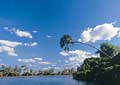
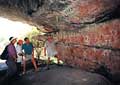
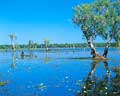
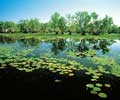
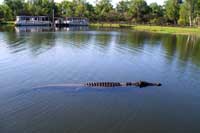
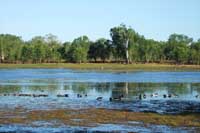
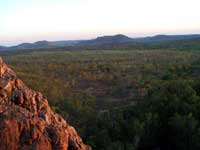
Kakadu is located about 200km. east of Darwin, it is a spectacular Aboriginal owned World Heritage Listed National Park, covering over 1.3 million hectares with a very varied landscape that includes swamps, wetlands with rich birdlife, Aboriginal rock paintings, rivers and billabongs with crocodiles, a uranium mine, spectacular gorges and waterfalls, campgrounds and resorts, patches of monsoonal rainforest and savannah.
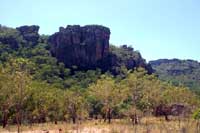
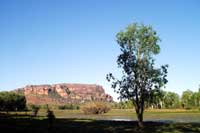
To the east of Kakadu an escarpment dramatically rises high above the plains and behind this lies Arnhem Land, a huge Aboriginal reserve that you can only enter with permits from the Northern Land Council or on a guided tour. Click to enlarge some of the images below to appreciate the vastness of the plains and the feeling of wilderness...
Click here for the best accommodation deals in Kakadu


 |
 |
 |
 |
The origins of the name Kakadu are not real clear, it is
thought that anthropologist and biologist Sir Baldwin Spencer called the
local Aborigines Kakadu when he visited the area in 1912, others think
it is just a word with no real meaning. There are many Aboriginal art
sites around Kakadu, with some of the paintings dating back more than
6000 years, some are open to the public and others are closed or kept
secret. Some of the more popular art sites include Ubirr in the northern
part of the park that has some great rock art, and Nourlangie in the southern
part. While Europeans have only four seasons, the local Aborigines have
six seasons;
January - March: Gudjuek (wet season), big thunderstorms, lots of rain
and high humidity.
April: Banggereng (storm season), violent storms and rains knock down
the long-grass.
May - June: Yekke (mist), water levels are still up, but most terrain
is accessible.
July - August: Wurrgeng and Gurrung (dry season), wildlife and birds are
increasing in numbers.
September - October: Gunumeleng (build up season), humidity goes up ,
temperature goes up and the mosquitoes increase in numbers.
November - December: thunderstorms with lightning start and continue into
the wet season, the Territory is famous for its lightning, photographers
travel from far and wide to capture this phenomena.
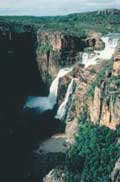
Jim Jim Falls and Twin Falls are spectacular waterfalls, but
require some effort being located 60km. down a dirt road, when it
rains the road gets cut off and when it does not rain for some time
the falls dry out so you need to pick the right time. Getting to
Twin Falls involves a swim as well as there is no road access. Small
planes and helicopters can give you an awesome view of the roaring
falls in the wet season. |
|
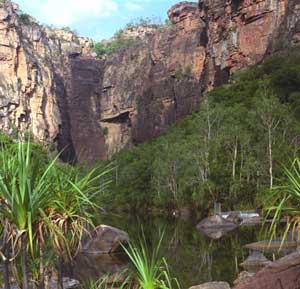
The park has a choice of walking tracks varying from 1 to
12km to explore the area, and several campsites.
Kakadu is popular with bird watchers, the wetlands attract thousands of
birds, some species that you may spot here are brolgas, bustards, cockatoos,
kites, cormorants, darters, ducks, eagles, egrets, herons, ibis, jabirus,
kingfishers, magpie geese and pelicans. Some birdwatchers prefer the end
of the dry season to visit as birds then congregate around the last remaning
waterholes and are easier to spot. As many as 100 000 magpie geese can
flock together on the South Alligator River. Another popular place with
bird watchers is the Mamakala Observation Point, a bird hide along the
Arnhem Highway on the way to the park built on the edge of a lake where
thousands of birds tend to concentrate.
Besides birds and crocodiles there are also some less welcome animals
that inhabit the park; waterbuffaloes, feral pigs, horses and donkeys
run wild and damage delicate wetland ecosystems, and recently the cane
toads have started arriving too. The cane toad is basically a poisonous
frog introduced from South America, and is Australia's biggest blunder
of all times. In the 1933 scientists, paid by the Australian government,
went overseas to collect canetoads and set about thirty of them free in
North Queensland. The idea was that they would eat the beetles that were
causing economic damage eating the sugarcane but unfortunately the cane
toads never touched the beetles but helped themselves to everything else
they could find. Wildlife smaller than them they will kill and eat, wildlife
bigger than them will eat them and die from the poison they have in glands
on their back. The thirty toads that were introduced initially have now
multiplied into the countless millions and are spreading across Australia
and have recently arrived in Kakadu where it is expected they will devastate
the place as there are vast floodplains which are the perfect breeding
ground for them.
Uranium was discovered in 1969 in Kakadu, and has been mined since 1981 in two places at the Ranger and the Jabiluka Uranium Mines. 6 million tonnes per year is dug out of a big open pit that produces 3000 tonnes of uranium oxide per year. This has caused much controversy over the years, and UNESCO has paid a visit to assess the situation as they considered removing Kakadu from the World Heritage Listing. The Aboriginal owners of the land are being paid royalties by the mining company through the Northern Land Council, and strict environmental controls are in place to monitor the quality of water being released by the processing plant. The mining company ERA runs regular free one hour long tours of the mine and the mill which you can book on (08) 8979 2411 .
Jabiru is a small town in the middle of Kakadu, the majority of the population are the uranium mine workers, and you will find shops and more facilities than in most towns that are this remote, including a hotel in the shape of a crocodile. When this hotel was announced in the 1980s all the locals thought is was an April Foolsday joke.
Weather wise the most pleasant time to visit Kakadu is between April and September. If you come early in the dry season the waterfalls will still be running. During the dry season you may see bushfires, hese are usually controlled burnoffs. Aborigines have been managing the landscape for thousands of years by lighting fires, this way the long grass is burned every year in relatively low-heat fires and will not build up in to a mass of fuel that would kill the trees, animals will flee from the fire and can be easily caught, and green grass will grow after the fire, attracting more animals that can be hunted. Many species of trees have become so used to the fire that their seeds will not germinate unless they have been through a fire, so now the landscape has to be burned every year. Australia must be one of the few countries around the world where National Parks actually sets their own parks on fire!
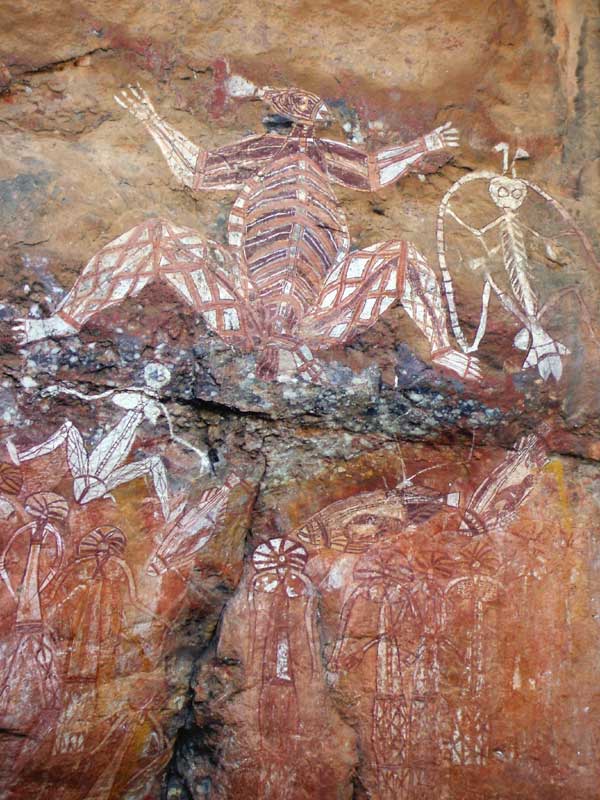 |
Nourlangie Rock is located south of Jabiru and there are over 100 sacred sites with Aboriginal rock art in this area but not all are open to the public, some of the paintings include thylacines, or Tasmanian tigers, which once lived all over Australia, but by the time Europeans arrived only in Tasmania, where the last one died in Hoabrt Zoo in 1936. |
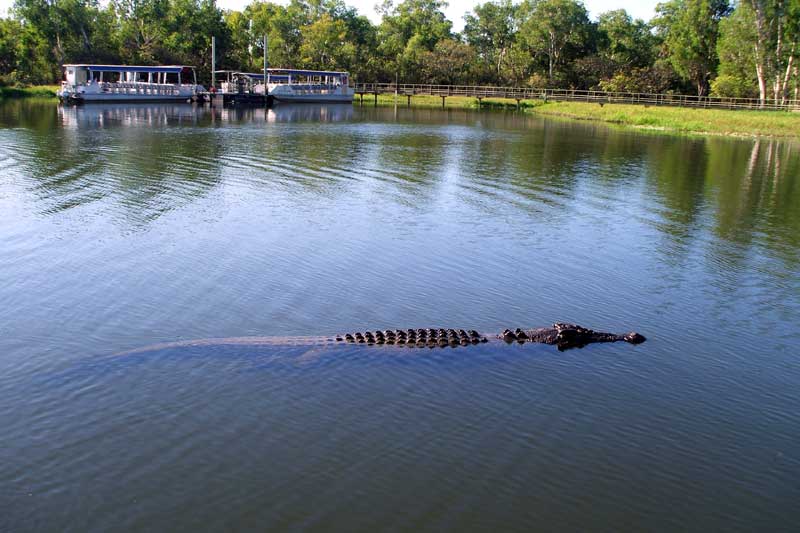 |
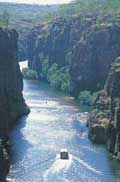
Yellow Waters billabong is one of the most popular areas within the park, being easy to access by vehicle and offering boat cruises to spot the abundant wildlife and crocodiles. The Cooinda Motel is here for those that decide to stay overnight. |
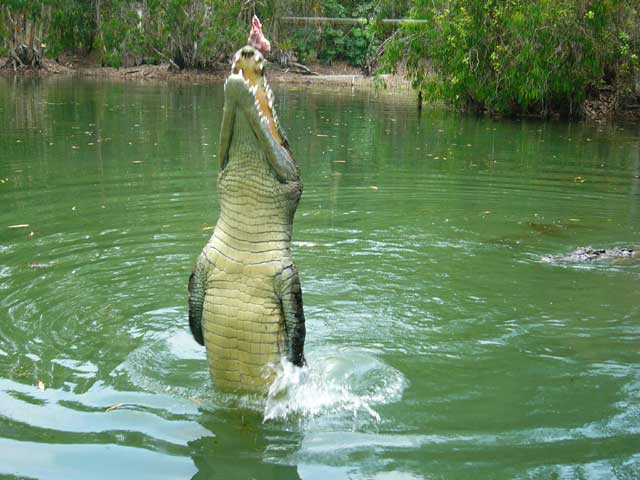
On the way from Darwin to Kakadu you can go on the
Jumping Crocodile Cruise on the Adelaide River. This is not a circus
trick that the crocs have been taught, crocs naturally launch themselves
out of the water to catch low flying birds. When this tour started
local fishermen were not happy at all as they thought this would
teach the crocs to drag them out of their boats but it has been
running for a few years now and so far so good. |
|
Getting to Kakadu
Unless you drive up to the Northern Territory you will have to fly to the nearest airport Darwin first, and then rent a car or book on a tour.
If you are already in Australia then go to our page Cheap Domestic Flights in Australia for a good choice in cheap domestic airfares to Darwin.
If you are still in your home country then you will need to get an international flight to Darwin.
ZUJI is an online travel agent with offices throughout the Asia Pacific region, offering you a choice of more than 400 airlines and 60,000 hotels, as well as car hire and travel insurance.
Feel more comfortable to book your airfares to Darwin online with a travel business from your own country that you know and trust?
Then choose your home country here:


Car hire for Kakadu
Rent a car to get to Kakadu! Kakadu is about a 200km. drive
east of Darwin, and with your own car you will be able to visit several
other attractions on the way such as Berry Springs, Fogg Dam and the Jumping
Crocodiles on the Adelaide River.
There is a wide choice of car rental companies where you can book your car or campervan online to be assured of a car on your arrival in kakadu or at Darwin airport, and most offer one way rentals between major cities. Nothing beats the freedom of having your own car to explore and stop when and where you want.
Budget Car Hire needs little introduction, the name says it all: car hire at Budget Prices with a car hire company with an international reputation, and this sites makes it even easier to find yourself a cheap hire car, or anything else with wheels: trucks,buses, campervans, utes, four wheel drives etc.
See Kakadu and the N.T. in a campervan
Kakadu is the perfect place to go with a camper van! Wide
open roads, countless beautiful spots to pull over and camp, the freedom
to go where and when you want.
Nothing beats finding your own camping spot in the wild, having a cold
beer admiring a wildly coloured outback sunset and a dinner cooked on
the campfire under the magnificent starry skies.
Discovery Campervans is an Australian owned and operated company that specialises in organising campervan rentals in Australia but also in New Zealand.
Their fully qualified team handle your reservation queries and overlook all rentals placed. The benefit to you of having a dedicated team is that it provides a level of professionalism, product knowledge and experience to ensure that your rental goes smoothly, and you can enjoy your trip without any hassles. Yes, REAL People work here!
Discovery
Campervans has been built and developed with the support
and continuing assistance of the largest campervan rental companies in
both Australia and New Zealand....
By booking your campervan hire through the Discovery Campervans website,
you get to take advantage of our clever technology - showing up to date,
competitive comparitive prices - and have the security of renting with
established and leading brands in the campervan hire market.
Compare Britz, Maui, Backpacker, Kea and Apollo on one easy to use website.
Save Quotes, look at the layouts and full specifications and compare prices
and package inclusions.

See our page Campervan hire in Australia for more useful info and links on renting a camper or RV in Australia
Relax and let someone else do the driving!
See the whole range of Kakadu tours here...
|
|||||
|
||||
|
|||||
|
|||||
|
|||||
|
|||||
Accommodation in Kakadu
Camping in Kakadu
There are quite a few camping sites within the National Park including Malabanbandju, Mardukal and the Jim Jim Billabong Camping Areas. The Ranger Headquarters have all the details, brochures and maps.
Crocodiles in Kakadu
Be aware of crocodiles in Kakadu, they have perfected their hunting techniques for millions of years and can swim under water at 30 km/h withhout a ripple on the surface and then burst out and on a short distance can outrun a horse. If a prey puts up too much resistance they will do the "death roll" to get it off its feet. They even jump out of the water to catch low flying birds and, on the "jumping crocodile tours" they raise themselves out of the water and "stand" on their tail for a few seconds to grab a piece of meat. Many crocodiles are large enough to catch and kill animals as big as cows, horses and water buffaloes, females can grow up to 4 meters in length, males can reach 7 meters in length and weigh over 1,000kg. On average one person a year in Australia is killed, usually by ignoring some of the common sense safety rules. Click here for more info about crocodiles or here for more about crocodile attacks in Australia , including some in Kakadu. Below you can observe the difference between salties and freshies, the freshies are OK to swim with, the salties are not. |
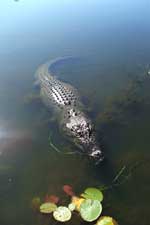 |


Saltwater
Crocodile (Crocodylus Porosus)., Kakadu NP, Australia
Buy
this Photographic Print at AllPosters.com

Freshwater
Crocodile (Crocodylus Johnstoni), Kakadu NP, Australia
Buy
this Photographic Print at AllPosters.com
Kakadu accommodation - Kakadu tours - Transport to Kakadu - Crocodiles in Kakadu - Photos - Map

HOME PAGE
Tourist Information
General Information
And Entertainment
ACCOMMODATION IN AUSTRALIA
Bed
& Breakfast
Budget
Accommodation
Backpackers Hostels
Hotels
in Australia
CAR HIRE IN AUSTRALIA
Australia Rental Cars
And
Campervans


TOURS
IN AUSTRALIA
What To Do In Australia
On-line
Shopping
On-line
Dating

About
Australia
Visas For Australia
How
To Get To Australia
How To Get Around
Travel Insurance
Travel Guides
Working
In Australia
Australian
Posters
Survival
Tips
Weather,
When To Go

Use of
this website constitutes acceptance of the User Agreement for this website
Contact us |
Advertise on this site
| Link to this site |Add
your photos or stories to this site |
Webmasters | Affiliates