 Accommodation | International
Flights | Domestic
Flights | Tours
| Travel
Insurance | Car
Hire | Visas
| Shopping
| Dating
| Humour
Accommodation | International
Flights | Domestic
Flights | Tours
| Travel
Insurance | Car
Hire | Visas
| Shopping
| Dating
| Humour
Amazing Australian Trees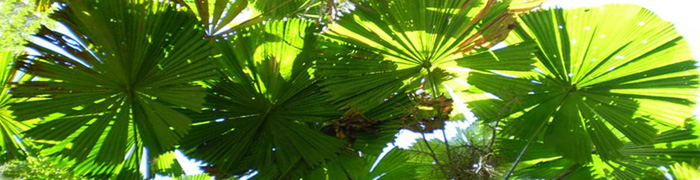
Australia supports more than 25,000 species of plants and trees!
They vary from beautiful to bizarre to painful to poisonous, and there's some pretty amazing ones amongst them;
Black Palm
Normally palms are soft inside and not useful as timber but the black palm is the exception with its trunk being one of the hardest types of wood known. It is usually only the bottom metre or so that is this hard though it ca run higher than this. The palm is found in North Queensland and bears red golf ball size seeds and is similar in appearance to the infamous foxtail palm. The timber is used for small craftwork as it is not available in big enough quantities to do anything else with.
Boabab
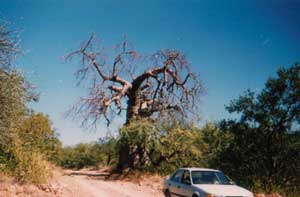
Photo by Rob Lapaer of Rainforest
Hideaway B&B, Cape Tribulation, N.Qld.
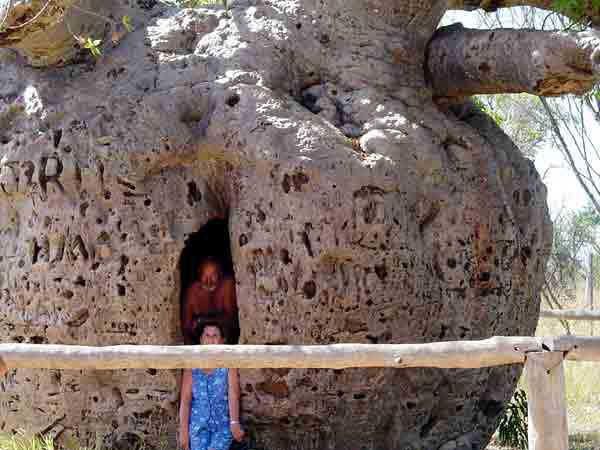
In Africa they refer to this as the upside down tree as the branches resemble tree roots and the whole thing looks like it was picked up, turned around and whacked back in the ground. Pronounced as Boab this tree is evidence that Australia was once connected to Africa, they can be found in the Kimberleys in northern W.A. , the most famous one being the prisoner tree at Derby. This is a big hollow tree that was once used to house prisoners.
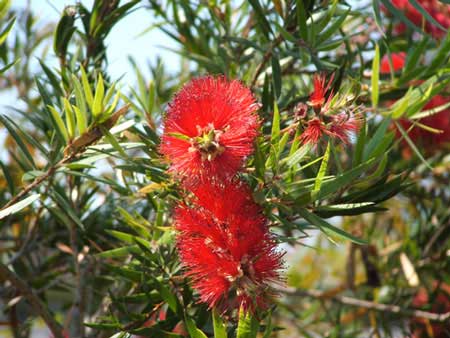
Bottle brush
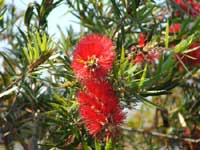
Bottle brush
Photo by Bethwyn Boyt-Cullis.
Fanpalm
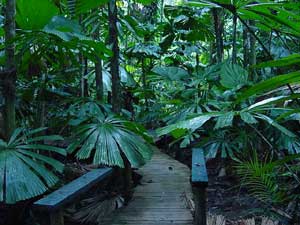
Fanpalms on the Dubuji boardwalk at Cape Tribulation
Photo by Rob Lapaer of Rainforest
Hideaway B&B, Cape Tribulation, N.Qld.
Foxtail Palm
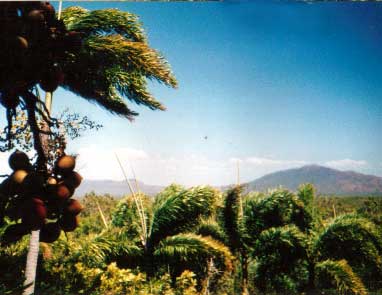
Photo by Rob Lapaer of Rainforest
Hideaway B&B, Cape Tribulation, N.Qld.
Foxtail palms in the remote Cape Melville region of north Queensland
The Foxtail Palm, (Wodyetia bifurcata) was named after
Wodyeti, an Aboriginal bushman, who was the last of his line holding
a vast traditional knowledge of the palm's natural habitat, the
Bathurst Bay-Melville Range in Far North Eastern Queensland, Australia.
The reason why this Australian native lay undiscoveredfor so long
is that it occurs naturally only in this very remote region of north
Queensland. During the 1980s and 1990s poachers used to raid the
palms to sell the seeds to nurseries and so this solitary feather-leaved
palm was only introduced legally to the nursery trade in Australia
in 1995, though long before foxtail palms could be seen in gardens
and city parks, while one government department was pursuing criminals
that dealt in the seeds another was busy buying and planting them.
The Foxtail Palm is prized by palm enthusiasts and landscapers for
its thick, robust trunk and neat appearance, especially the arching
crown of light green fronds which, as the name suggests, gives the
palm's foliage the appearance of a fox's tail as it sways in the
breeze. The Foxtail Palm is now one of the world's most popular
landscape palms.
Idiospermum
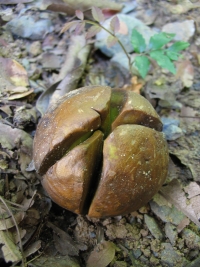
Idiospermum seed
The Idiospermum was one of the first flowering trees
to evolve and was thought to have been extinct until discovered
fairly recently in the Daintree area.
When farmer John Nicholas in the Daintree kept finding one dead
cow after another he called in the vet whose opinion was that it
looked like strychnine poisoning. First the farmer suspected neighbours
of killing his cows but when the vet examined the cows he found
tree seeds inside their stomachs that he sent away for analysis.
It took some time for the results to come back as the seeds could
not be identified but finally, after going as far as Germany where
some old research results from an Australian fieldtrip were filed
away the conclusion was the seeds were from an Idiospermum, one
of the first flowering trees to evolve on this earth but thought
to have been extinct for millions of years! Scientists rushed to
theDaintree farm but were in for a shock. The farmer meanwhile had
also concluded that the seeds had killed the cows so what do you
do then? Of course! You get your chainsaw and cut the tree down!
After their initial heart attack on arrival the scientists later
managed to find more Idiospermums.
The Daintree without a doubt still has countless secrets and new
species to be discovered, at the canopy crane at Coconut Beach where
scientists get lifted up in a gondola to study life in the canopy
many thousands of new insects have been discovered in only a couple
of years.
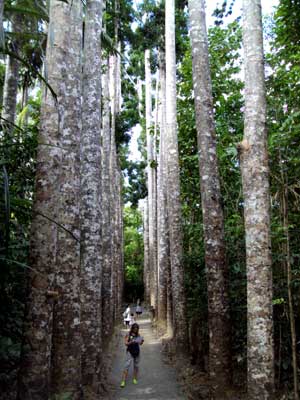
Kauri pines at Paronella Park
Mangrove
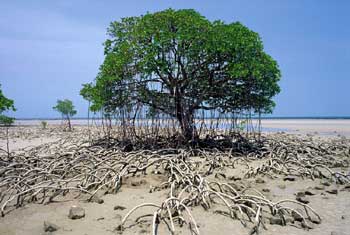
A very special kind of tree able to survive in salt water in tidal flats where its roots are often submerged. Mangrove areas used to be regarded as mosquito and sand fly havens best cleared to make room for waterfront developments but in more recent years people have come to understand that they are important breeding grounds for lots of things at the bottom of the food chain and loss of mangroves actually translates in reduced nmbers of fish in the ocean. There are many types of mangroves that all have different ways to survive the difficult conditions where they grow. Some have spongy tissue on the roots in which they store oxygen that help them through the time they are under water, others have 'snorkels' sticking up from their roots that they use to get oxygen as the mud in which they sit holds no oxygen like normal soil does.
Mountain ash
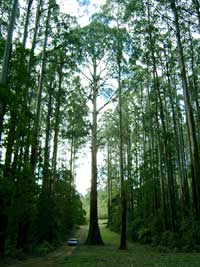
Photo by Malcolm Cobb
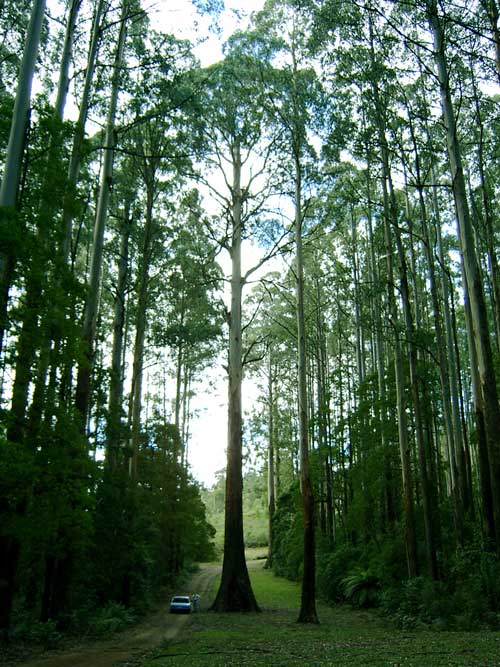
Malcolm Cobb sent us this great photo of his car totally dwarfed by huge mountain ash (eucalyptus regnans), 60 km. from Melbourne. (Click to enlarge.)
Pandanus
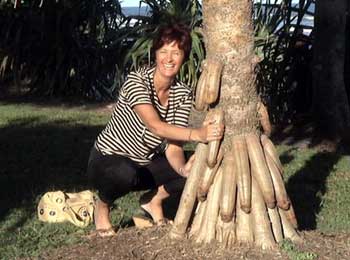
This versatile tree is found from bare dry rock on
Australia's east coast to the swamps of the Northern Territory,
and also in the surrounding Asia Pacific region.
The genus includes at least 600 species and plants vary in size
from small shrubs less than a metre to taller trees up to 20 metres.
The trunk is usually solid, ringed with many leaf scars and they
often have many thick prop roots near the base to provide support
as the tree grows top-heavy with leaves, fruit, and branches. The
leaves are strap-shaped, varying between species from 30 cm up to
2 m or more long, and from 1.5 cm up to 10 cm broad.
They grow a fruit measuring 10 to 20 cm in diameter that looks
similar to a pineapple that changes from green to bright orange
or red as it matures. The fruit of some species are edible and eaten
by animals including bats, rats, crabs, elephants and monitor lizards,
the Australian Aborigines also eat them but the fruit requires some
preparation to make it edible.
Pandanus leaves are also used for handicrafts, in cooking, as housing
materials, clothing and textiles including the manufacture of dilly
bags (carrying bags), medication, decorations, fishing and religious
uses.
Stinging Tree
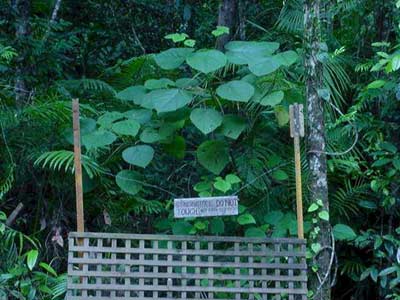
A healthy specimen of the infamous stinging tree next to the carpark
at Rainforest
Hideaway B&B, Cape Tribulation
The stinging tree, also known as Gympie Gympie is found throughout Queensland and has the ability to inflict extreme pain on those unlucky enough to brush against the hairly leaves. Also jokingly referred to as bushman's toilet paper because of the unconfirmed story of the poor soldier that after a crap in the bush chose the large leaves of a nearby stinging tree to use as toilet paper. The pain is caused by a chemical that gets injected into the skin by microscopic hollow fibreglass hairs that get stuck in the skin and can cause pain up to three months after the initial sting. During World War Two the British Army sent some people up to North Queensland to collect a few bags of the leaves to take back to Cambridge where the chemical was identified. The reason for this expedition had been to investigate the possibilities of using this extremely nasty compound in a military weapon but was never developed.
Some stinging tree encounters:
One day a few guests arrive that were not looking overly happy. Once they settled in a bit and we got talking I found out why. They had stopped at Mossman Gorge on their way to Cape Tribulation and after their walk discovered that the luggage had disappeared from their convertible. At first thinking some joker might have thrown it in the bushes behind the car they started searching in the greenery only to find that most of it was stinging trees!
Another time I get an Italian family arrive, they look around, love the place and all's going well. Until 5 minutes after their arrival when their 8 year old son goes up a track to my place where he's not supposed to go anyway and then deviates off the track a metre and hits a 10 cm. high stinging tree seedling with his ankle. I had seen the little plant there before but as it was well out of the way of the guests had never worried about it before. Now all hell had broken loose though, the little boy was screaming his head off, the parents stressed out to the max etc. What to do now... I remembered a trick that an old bloke married to an Aboriginal woman had told me; cut a banana sucker and rub the juice on the stung area. I ran to the road and cut whatever banana suckers I could find but it had not rained for a few months and I could not get a drop out of them. I remembered another thing; twice I had asked old Aborigines about what they do in the case of a stinging tree encounter and both times the answer was; just piss on it. I had tried this once myself when I got a little sting on my lower leg and I must say the burning sensation disappeared immediately after being touched by the urine but what was I supposed to do with this situation; a certain degree of excentricity is accepted of all Aussies and certainly B&B owners but to unzip and give their son the golden shower 10 minutes after their arrival would probably go just a little bit too far. I ended up driving to the Bathouse just down the road where the owner/scientist gave me some diluted hydrochloric acid that I put on the sting and thank goodness the boy calmed down and the drama was solved.
Photo and story by Rob Lapaer of Rainforest Hideaway B&B, Cape Tribulation
Dexter Boneham from Brissy told us how as a kid he got a sting on his hand, his father then got his cigarette lighter out and burned his skin to the point where it came off and when (eventually) the new skin grew back after much agony this did not have the microscopic hairs in it. This is not a recommended cure, we suggest to try waxing instead.
Strangler Fig
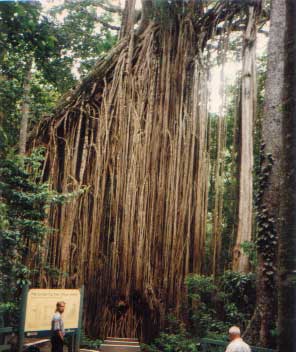
Photo by Rob Lapaer of Rainforest
Hideaway B&B, Cape Tribulation, N.Qld.
The curtain fig tree in the Atherton Tablelands
This tree does things opposite from the other trees. It starts off when a seed in a bird dropping lands in the top of another tree. It will send its roots down the trunk of the host tree until they reach the soil and then both tree and roots will continue to grow until they eventualy will have totally enveloped the host tree. Some say the host tree does not actually get strangled but gradually dies because the strangler fig takes so long to develop and gradually shades the host tree depriving it of sunlight. Whatever it is they make beautiful trees and you can see some very impressive specimens in the Atherton Tablelands west of Cairns in North Queensland, the Cathedral Figtree and Curtain Figtree are well known attractions there admired by thousands of people each year.
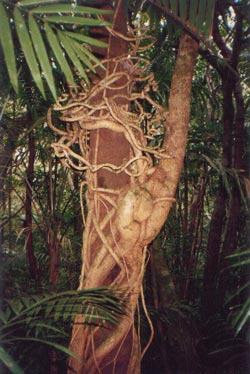
Photo by Rob Lapaer of Rainforest
Hideaway B&B, Cape Tribulation, N.Qld.
Tar Tree
Found in North Queensland and known for its extremely aggressive chemicals. Early 2004 a team of tree loppers in Port Douglas had to be taken to hospital after being severly affected when he got covered in vegetation matter when a tar tree was put through the mulcher. Earlier a girl swimming in Emmagen Creek, north of Cape Tribulation also needed medical care after swimming in a water hole where seeds form the tar tree had dropped in.
Wollemi Pine
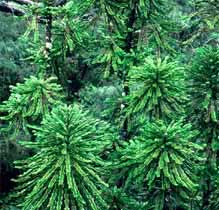
Photo by www.wolemipine.com
The Wollemi Pine (Wollemia nobilis) was discovered
purely by chance near the Blue Mountains by bushwalker David Noble,
a NSW National Parks and Wildlife Officer, in 1994. It is one of
the oldest and rarest trees in the world and related to the Kauri,
Norfolk Island, Hoop, Bunya and Monkey Puzzle pines.The Wollemi
Pine belongs to the 200 million year old Araucariaceae family and
was thought to be extinct, the oldest known fossil is 90 million
years old! Their location is kept secret as there are only a hundred
mature trees found. The Wollemi Pine is a conifer with attractive,
unusual dark green foliage, bubbly bark and sprouts multiple trunks.
It grows fast in light, favours acid soils, and temperatures from
-5-45°C . The largest wild Wollemi Pine in the rainforest gorge
is 40m tall with a main trunk of 1.2m wide. Conservationists have
given the tree its own website where you can get involved in the
conservation of this tree, more
info...
Do you know of any amazing Australian trees? Then contact us!

HOME PAGE
Tourist Information
General Information
And Entertainment
ACCOMMODATION IN AUSTRALIA
Bed
& Breakfast
Budget
Accommodation
Backpackers Hostels
Hotels
in Australia
CAR HIRE IN AUSTRALIA
Australia Rental Cars
And
Campervans


TOURS
IN AUSTRALIA
What To Do In Australia
On-line
Shopping
On-line
Dating

About
Australia
Visas For Australia
How
To Get To Australia
How To Get Around
Travel Insurance
Travel Guides
Working
In Australia
Australian
Posters
Survival
Tips
Weather,
When To Go

Use of
this website constitutes acceptance of the User Agreement for this website
Contact us |
Advertise on this site
| Link to this site |Add
your photos or stories to this site |
Webmasters | Affiliates