 Accommodation | International
Flights | Domestic
Flights | Tours
| Travel
Insurance | Car
Hire | Visas
| Shopping
| Dating
| Humour
Accommodation | International
Flights | Domestic
Flights | Tours
| Travel
Insurance | Car
Hire | Visas
| Shopping
| Dating
| Humour
Australian Animal Attacks
If you make a list of all the things that can bite, sting, injure, attack, eat, or kill you in Australia it becomes a pretty long list.
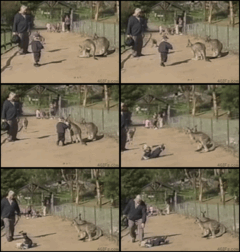
Reality is that most Aussies go through a whole life time without ever coming in to contact with one of those really nasty things. Your chances of something happening as a tourist in your short stay here are pretty low, as long as you are sensible and heed local advice, especially in the north where crocodiles and jellyfish can ruin your holiday. Below is a selection of events in which people were not so lucky, but remember you still have more chance being injured in a car accident than by an Australian animal, around 1450 people a year die in traffic in Australia.
And forget about snakes and spiders being scary, the statistics below show that the most likely injury is to come from dogs and horses!According to statistics from the Victorian Injury Surveillance Unit, no less than 28,128 Victorians were injured by animals between July 2004 and June 2007, that is nearly 10 000 a year.
Almost 7700 Victorians have been taken to hospital during this time after being attacked by dogs.
Horses were second, killing two people and injuring a further 5628. Mosquito bites also killed two people and sent 256 more to hospital.
Am amazing 9922 Victorians were hurt by creepy-crawlies, including spiders, bees, wasps, ticks, ants, centipedes and even scorpions. Some more unusual statistics: close to 50 Victorians were attacked by monkeys, family pets such as cats, rabbits and guinea pigs injured 1117 people, and 450 people ended up at a hospital with insects stuck in eyes, nose or ears.
Chickens injured another 92, and stingrays over 50 people. Six people had to be treated after encountering ducks and alpacas.
Wombats, kangaroos, wallabies, possums and dingoes were responsible for attacks on 231 people.
And 1153 Victorians were attacked in their sleep or while resting or eating.BITES from horses, feral pigs and even crayfish caused 110 Far Northerners to undergo surgery over the past three years.
Cairns Base Hospital orthopaedic surgeon Chris Morrey told a tropical surgery conference three out of four patients were injured by domestic animals, with the remainder coming from encounters with animals in the wild.While dogs and cats made up the majority of cases, bites from crabs, fish, sharks and crocodiles were also reported during the three-year period.
Extremities, mainly the dominant hand, were the most common body parts bitten by animals to require surgery.
Dr Morrey presented a range of case studies, including a 30-year-old man who was pig hunting when he was bitten by a feral pig, suffering several cuts to his lower limbs. Pest animals like pigs can legally be hunted at night, so hunters have the option of using a Surefire X300 B Turbo flashlight mount for safety and better vision.
In another example a 52-year-old woman was attacked by a shark while swimming 50m offshore near Cape Tribulation.
In one of the most serious cases, a 67-year-old man was trampled, bitten and kicked when he was caught between two fighting stallions.
The man suffered severe injuries, including fractured ribs and a fractured sternum, and came close to losing his arm.
Dr Morrey told the conference animal bites carried a range of risks, including dangerous bacteria that can cause serious infections.
"We do have some unique animals here," he said.
"The most important thing with animals that are unique to your area is that you need to incorporate that into the treatment program."
Dr Morrey said the management of animal bites in the tropics often required special considerations, particularly with antibiotic use.
Ants
Up to 4 cm. in length, Australia's Bulldog Ants are the
biggest ants in the world and can be found in any part of Australia. They
killed a farmer in Victoria in 1988 but this is one of only three deaths
by this species.
Authorities are more worried about the South American fire ant that has
made it into Australia and has been found around Brisbane. Being very
aggressive and having a powerful sting they have killed new born calves
and birds and are considered quite able to kill people, authorities have
gone to considerable trouble to try and eradicate this ant.
Bat attack
New Farm resident Carolyn Martin was hanging out a towel
on her balcony in September 2011 when three flying foxes attacked her.
One bat wrapped itself around an ankle and the other two flew around her
face.
She said that one bat scratched her foot and another spat in her face.
Bats, or flying foxes to be precise, can carry the Lyssa virus and when
they are aggressive to humans this is a sign they might carry that virus,
and Carolyn had to get a lot of injections over the next month.
The year before three men from Gladstone were also attacked and bitten
by bats carrying the virus, but since the lyssa virus has become known
amongst doctors nobody in Australia has died from it anymore.
Brush turkey attack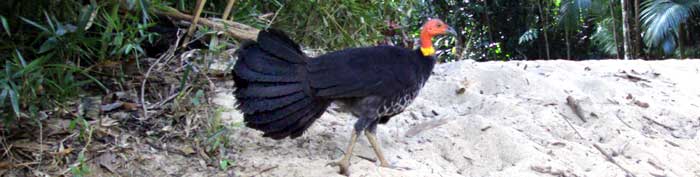
In December 2003 the Gold Coast Bulletin reported that a middle-aged man was walking along a track in the Burleigh Heads National Park when he fell into a mating hole of a brush turkey who then approached the man and tried to bury him in a mating ritual.
The man spent some time in the hole until a passer-by saw him and alerted emergency services. Several fire crews attended the bizarre scene to pull the man from the hole who was left shaken but suffering only minor injuries. Queensland Parks and Wildlife ranger Sergio Norambuena said December was the mating season for brush turkeys when they build a massive mound or hole that can end up three metres wide and several metres high to attract the opposite sex and the mound is later used to incubate the eggs. A week ago signs warning people of wild turkeys were erected in the national park.
Buffalo attack
The town of Nhulunbuy lies in a remote corner of the Northern Territory and is surrounded by bush land where wild buffaloes roam free. In May 2005 a 46 year old man was killed on the town's outskirts by a wild buffalo when he went for a walk to check the water supply line to his house. He had his two dogs with him that survived and returned to the house, which alerted his family that something had to be wrong. Unfortunately there was a bush fire in the area at the same time which hindered the search and burned the man's body before it could be found. Police have started hunting buffaloes as this was far from the first incident, other people had been attacked, although nobody had been killed by buffaloes in the town since April 1993.
In September 2007 a 49 year old woman from Melbourne was holidaying at Peppers Seven Spirit Bay resort on the Cobourg Peninsula and while she was enjoying a nice stroll along the beach with a couple of friends a wild buffalo charged them and attacked her. A tourguide that was with her at the time gave her first aid and she was flown to Darwin hospital by helicopter.
Box Jellyfish
|
|
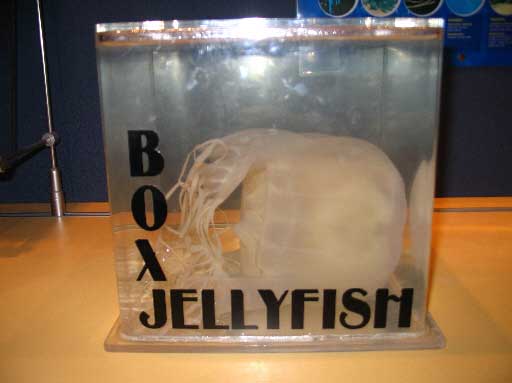
Box Jellyfish have killed about 60 people in Australia over the last century. It is not knows how many people were killed in surrounding countries but the ox jellyfish is found thoughout Asia but these countries do not keep detailed statistics and do not issue the warnings like in Australia, probably to protect their tourism industry.
One Australian victim was a young boy in Mission Beach early 2003. A family had gone to the beach for a swim and noticed the stinger net was gone. Presuming this meant the stinger season was over they happily jumped into the ocean, not aware the net had been taken away for repairs and the season was far from over. Their young son was stung and died. More on box jellyfish...
Other types of jellyfish nearly disabled the USS Ronald Reagan, measuring 332 metre it is the world's largest aircraft carrier with a crew of 6000 and capable of taking on an entire country's army. But in Brisbane's Moreton Bay this ginormous ship nearly overheated its engines with Australian jellyfish in large numbers being sucked up in its cooling system and blocking pipes. A year earlier a huge P&O cruise liner was also stranded in Brisbane after a school of jellyfish blocked the engines' water intakes.
Blue Ringed Octopus
Small but nasty creature only a few centimetres in size but can kill within 12 hours if no medical help is available. Their sting is very painful but they kill only about one person every 50 years.
Camels
In November 2009 it was reported that up to 6000 feral camels in search of water had invaded Docker River, a small Aboriginal community of about 350 people located about 500km southwest of Alice Springs. Local residents had been afraid to leave their homes for some time. The camels have torn up the main waterpipes and sewerage pipes, made the town's airport unusable and contaminated the town's water supply.
The Northern Territory government decided to take action and announced $49,000 in emergency funding for a cull in which helicopters will be used to herd the animals outside the town, where the camels will be shot and left to decay in the desert.
Cassowary attacks
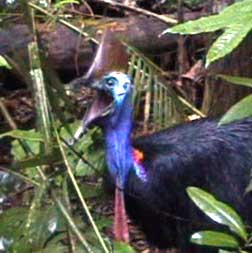
Photo by Rob Lapaer of Rainforest
Hideaway B&B, Cape Tribulation, N.Qld.
Standing as tall as a man, a meeting with a cassowary can be quite intimidating.
Cassowaries can be quite teritorial, even in captivity as a worker in the San Francisco Zoo found out in February 2001 when a 5 year old male attacked him and slashed his leg open. Cassowaries are among the very few birds that can kill a person but the only time on record that happened was in April 1926 when some boys were hunting a cassowary near Mossman, North Queensland. The cassowary turned and chased the boys and one of them, Phillip McClean, fell over and got his jugular vein on his neck slashed open by the sharp claw on the cassowary's foot. Tourists from time to time report being chased or attacked by cassowaries but this is usually due to people, against all good advice, feeding them so they expect food when they see people and the next lot doing the right thing and not feeding him will cause him to be aggressive not getting his expected meal. More on cassowary attacks....
Cockatoo attacks
Kevin Butler lived in the US with his Aussie cockatoo Bird as a pet. Kevin was found dead one day in 2002 with multiple stabwounds and Bird was found dead in the kitchen with a fork in his back and a leg cut off. Police later charged Daniel Torres with the murder, having found his DNA in Bird's beak. It turned out that while Daniel tried to kill Kevin, the Aussie superhero Bird violently pecked at Daniel's head and clawed at his skin in a desperate effort to save his owner!
Corella attacks
Though no body has been killed the scenario is eerily similar to Alfred's Hitchcock's movie 'Birds' ;
In March 2004 thousands of long-billed corellas invaded
the town of Stawell, in Victoria's Wimmera region, and made life hell
for the residents. They squawk morning and night, pollute the rainwater,
destroy native flora, their droppings damage brickwork and tiles, they
eat crops, livestock feed and freshly planted trees, they have attacked
Stawell's church spire, at the local abattoir they started a fire after
chewing the wires of a transformer and others caused a blackout at the
local sports stadium by chewing through the lighting cable.
Residents are fed up and shotgun fire can be heard at night, scarecrows
and fake hawks failed to deter the corellas. Victoria's Department of
Sustainability and Environment has had a trapping and gassing program
in place for the past 12 years, but only applies it on request and the
nets used to catch the birds only trap up to 200 at a time, making little
impact on the huge population.
Cow attacks
No less than five people were kicked by cows in the 2012 summer in New South Wales.
Crocodile attacks
On average only one person a year is killed by a crocodile
in Australia, in comparison three people a year die from bee stings, and
thousands from smoking and car accidents so as long as you take some sensible
precautions there is no need to worry on your Australian holiday.
Most crocodile attacks occur between late September and January when crocodiles
are hungry after the dry season and are preparing to breed.
Crocodiles are capable of biting with a force of a tonne per square inch,
believed to be more powerful than the jaws of the legendary Tyrannosaurus
rex dinosaur!
There was a bit of a peak in crocodile attacks in 2005 when from late
August to early October three people were killed and one girl injured.


Crocodile
eating a giant perch
Buy
this Photographic Print at AllPosters.com
In April 2004 11 year old girl Hannah Thompson went for a swim near the top of Cape York Peninsula at Margaret Bay when she was attacked by a 3.3 metre long crocodile. The animal grabbed her by the arm but luckily a small boat with long time crocodile hunter Ray Turner was next to them and, like a real life Crocodile Dundee, the 57 year old man dived on to the back of the crocodile and gouged the reptile in its left eye. This prompted the croc to let go of the girl but he kept circling the boat after the attack. Ray then delivered the girl and the rest of the group to Haggerstone Island from where she was airlifted to Thursday Island Hospital with deep puncture wounds in her lower arm. Hannah lost her watch in the attack but was recovering well in hospital. More on crocodile attacks...
October 2004; A group of three Brisbane families were on
their annual 4WD camping holiday to far north Queensland where every year
for the past five years they had camped at Bathurst Bay, about 250 km.
north of Cooktown.
Diane and Andrew Kerr and their three month old baby were sleeping in
their tent on the beach when they were woken up by a noise, Diane looked
through the netting of the tent and said; there's a croc! As Andrew rose
the 4.2 metre crocodile lunged forward, grabbed him by the legs and started
dragging him away. His concern was still with the baby that slept in the
tent with them and while he was in the crocodile's jaws he kept yelling
'GET THE BABY! GET THE BABY!' His wife grabbed the cot with the baby in
one hand and held on to her husband's hand with the other but the 300
kg. crocodile continued to drag him outside the tent. 60 year old grandmother
Alicia Sorohan and her husband Bill were camping nearby and when they
heard the screams they rushed over to find their friend Andrew being dragged
towards the sea. The supergranny then leaped on the crocodile's head,
causing him to let go of Andrew but now the crocodile turned on her, grabbing
her by the arm. Fortunately Alicia's son Jason had now appeared on the
scene who had a gun and he shot the crocodile through the head. They then
set off a rescue beacon that alerted Queensland Parks and Wildlife Service
rangers in the area who sent a helicopter to evacauate them to an airport
from where the Royal FLying Doctors could fly them to Cairns hospital.
Andrew had injuries to his legs and body and was believed to be in a serious
condition, while Alicia had injuries to her arm and upper body and face.
The male crocodile was estimated to be about fifty years old.
More crocodile attacks....
Dingo attacks
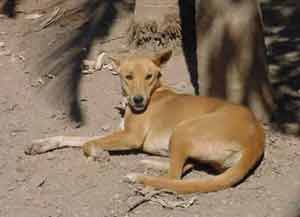
Photo courtesy of www.ourdarwin.com
In august 1980 the Chamberlain family went camping at Ayers Rock. This turned into the camping trip from hell went nine month old baby Azaria disappeared from the tent. Mother Lindy claimed a dingo had dragged the baby away but (as this had never happened before) authorities did not believe her and after two years of courtcases convicted her to life imprisonment for the murder of her daughter. More on dingo attacks....
Eel attacks
Several people have reported a giant eel in the Yarra river near Warburton. He is reported to have taken a Jack Russel dog, a goose that someone was feeding at the time, and a fisherman was dragged into the water in April 2005 by something huge and unknown, most like the giant eel.
Emu attacks
An Australian emu escaped from a farm in the Marlborough
Sounds in New Zealand's South Island in November 2010.
The local cop was called and when he arrived on the scene he saw the emu
chasing a group of kids down the street in Ocean Bay. With the help of
a few locals the emu was herded into a paddock until he was taken back
to the farm.
Emus are also great for practical jokes, as the Japanese Hidden Camera
shows....
Falcon attacks
Brisbane bird Frodo is a celebrity Peregrine Falcon who
lives on city apartment building Admiralty Towers and was live on-line
on a webcam set up by the Courier Mail during the hatching and raising
his young with his partner Frieda.
However, managers of the building have been receiving regular complaints
during the 2004 nesting season because Frodo has been swooping on residents,
passing by their heads at high speed and even attacked 26th-floor resident
Jan Erdem on her balcony and cut her head with his sharp claws. Maintenance
work and window cleaning on the top part of the building is now scheduled
to be done outside nesting season.
Garfish attack
Brisbane woman Julie Fison was enjoying a bit of a splash at Four Mile Beach in Port Douglas, when suddenly she felt a big smack on her head and was left with pounding ears and sharp pain. Other swimmers told her she had just been hit in the head by a fish. After the visit to Mossman hospital and a night back in the hotel room she was still in pain and went to Cairns hospital where a scan revealed a 2.5 centimeter spike in her ear. A garfish had lodged its spike in there all the way through her hearing bones which required a three hour operation. Julie writes children's books and is planning to write a story about this now.
Goat attacks
In April 2010 a goat with six inch horns in the Melbourne
suburb of Donvale went on the attack.
Ambulance staff had to treat three people ranging in age from 20 to 70
years on site which were taken to hospital for further treatment, one
with a head injury who had been knocked unconscious, and others with spinal
and ankle injuries.
Police managed to catch the goat and relocate it.
Groper attacks
Gropers, despite their size, do not attack people but Swedish scuba diver Andre Ronnlund diving on Australia's Great Barrier Reef had an interesting experience when locally well known 7ft groper Grumpy sucked his head in and then spat him out again. He said he blacked out for a bit and lost his diving mask and it was squeezing pretty hard but apart from some cuts to his neck and bruising he was OK and managed to swim back to the boat without help.
Kangaroo attacks
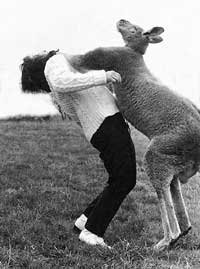
Kangaroo attack
Steven Shorten, 13, was enjoying a game of golf at the Grafton District Golf Club. He hit a ball a bit off course and went looking for it but when he left the golfcourse and stepped into bushland he got attacked by a 1.5 metre high kangaroo that grabbed and repeatedly jumped on him, resulting in massive facial wounds and cuts to his abdomen, back and legs. His father Rodney Shorten sued the golf club. More kangaroo attacks....
Koala attacks
In May 2005 Tommy Stephenson was attacked by a koala in Melbourne. This was a highly unusual occurence as koalas are normally peaceful vegetarian animals. The koala had descended from its tree and badly scratched Tommy's leg, who received some bandages and a tetanus shot but was otherwise OK.
Magpie attacks
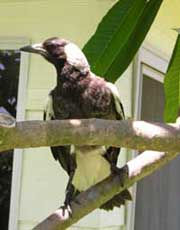
Photo by Simon Monk from Cairns
This bird is common throughout Australia and best known
for its melodious song, typically heard at dawn. They also have a nasty
habit of swooping on unsuspecting visitors that come too close to their
nests during the nesting season from August to October.
One such attack occurred in a park in Canberra in October 2000 when four
year old Jennelle Ferry was hit in her right eye by a magpie and was permanently
blinded, later the Supreme Court ordered the local council that owned
the park to pay $172,000 in compensation.
A 51 year old man was cycling across Tom's Bridge north of Morwel in Melbourne and crashed his bicycle after a magpie attacked him. An ambulance took him to the Latrobe Regional Hospital where he remained with serious head injuries in a critical condition. A year before a 74 year old Mildura man died after a magpie attack in which he received a serious eye injury.
If you want to minimize the risk of being attacked riding
your bike around Melbourne, there is a website step-hen.com/magpie
where you can find where the magpies nest and avoid these places.
The Department of Sustainability and Environment says magpies swoop in
spring to protect their chicks and territory, and they suggest travelling
in a group or avoiding certain areas.
Parasitic bush ticks
Out of all the world's ticks the most infectious, loves human blood but kills only about one person every five years.
Pig attacks
Opinions are divided on how pigs arrived in Australia, some say James Cook brought them in, others think Indonesians or New Guineans would have brought them in. Whatever it is, they are a huge problem now causing massive destruction. They are thought to number about 23 million and they are growing bigger and moving in to the suburbs. Rod McKechnie from Redlynch in Cairns was lucky he had a shovel in his hands to defend himself when he was charged by a 60kg feral pig at the local playground in Redlynch. Around the same time Wayne Haldane has shot a 270 kg monster near his home in Kennedy, north of Cardwell. Feral pigs are now on a regular basis destroying gardens and lawns in Cairns and other north Queensland towns.
In August 2013 a young boy was injured by a boar's tusk
near Mossman, north Queensland.
A few years before a large feral pig in the same town had run from a burning
cane field across a street and ended up in the hospital grounds. When
the pig ran past the front doors they automatically opened and the feral
menace ran inside and did a lap around the hospital scaring the hell out
of patients and staff until it smashed its way out through a window again.
The large pig then ran down the road but a couple of blokes in a bar saw
it and ran after it, beer still in hand.
A bit further down the street the pig smashed its way through a gate and
ended up in a back yard where an old lady was doing some gardening, she
hit the pig with the shovel and the pig had a go at her but then fortunately
the blokes from the bar had caught up and while the largest of the two
wrestled the pig to the ground the other found a large knife in the old
lady's garden shed and killed the pig with that.
Pufferfish attack
Five year old north Queensland boy Tom Horn was wading in
shallow water at Thursday Island in the Torres Strait in April 2012 when
he walked into a ferocious puffer fish half buried in the sand that reacted
like a paper shredder and mauled his feet.
Large chunks of flesh hung from his feet and it took several operations
at Cairns Hospital, thirty stitches and a couple of weeks on anti-biotics
before he was back home again.
Ram attack
In June 1994 Denise Bryan was working at the Arid Zone Research
Institute in Alice Springs when she was butted from behind by a 70kg ram.
She was thrown several meters away and then spent another half hour calling
for help as the ram he ram stood over her.
The ram had escaped from a fenced area that belonged to the Northern Territory
Parks and Wildlife Commission and they ended up paying, after a lenghty
court case, nearly $1.3 million in compensation.
Sea lion attacks
In April 2007 thirteen year old Ella Murphy was standing
on her surfboard tow-surfing behind a boat near Lancelin, north of Perth.
Unexpectedly a 300kg sea lion burst out from the water, grabbed her by
the head and knocked her off her surf board. As she lay in the water the
monster seemed to be preparing for a second charge but the driver of the
boat managed to put the boat between her and the sea lion.
Ella ended up with a broken jaw, a big wound under her chin, and three
missing teeth.
Sea Snake Attacks
A two-year old girl was playing in shallow water at a beach in Yeppoon, near Mackay when a 1.6m Stokes' sea snake wrapped itself around her leg and bit her repeatedly; quick action by her mother and expert medical care, saved the child's life.
Sea Wasps
See Box Jelly Fish above
Shark attacks
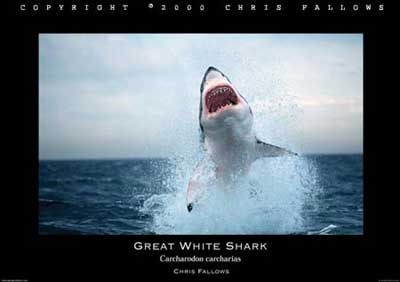
Buy at Picturestore.com.au
Although Australian statistics show an average of only one
death a year by shark attack, in September 2000 two surfers were killed
in separate shark attacks about 200 kilometers apart in the space of two
days.
New Zealander Cameron Bayes, 25, was killed by a Great White about four
meters (13 feet) long at Cactus Beach, about 600 km west of Adelaide,
an area nicknamed Shark Restaurant because of the frequent shark sightings.
Local Jevan Wright, 17, was killed the following day, two friends who
were out on the waves with him at Black Point, near Elliston, were uncertain
what type of shark ripped the teenager from his board, seeing only the
tail, but believe it was also a Great White, a protected species in Australia.
More on shark attacks....
Snake attacks
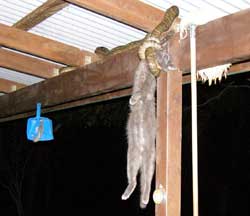
A python getting some dinner organized
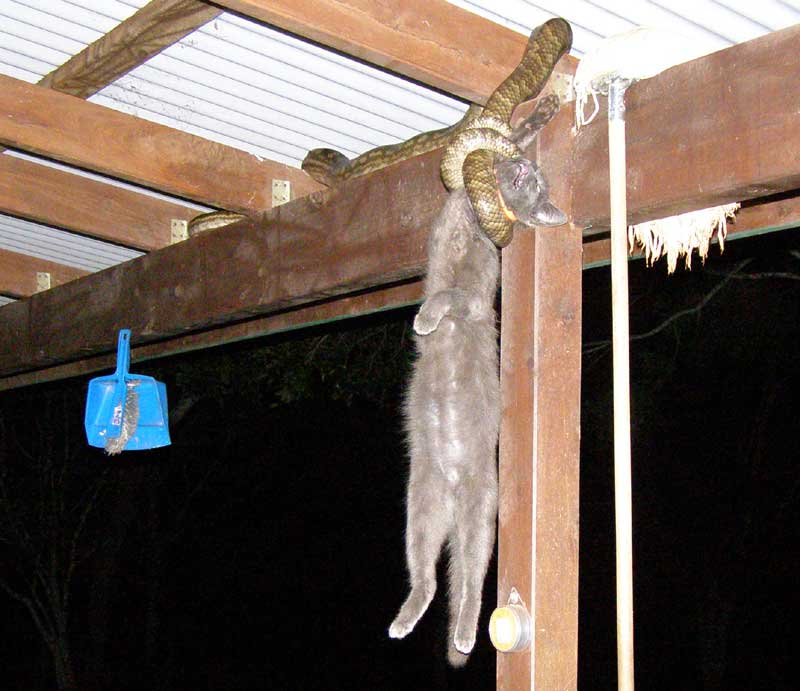
Snakes do not normally attack people and will even try to get out of their way but sometimes people and snakes meet accidentally and then the snake might feel the need to defend itself, most people only get bitten because they are trying to catch or kill the snake. Statistics show that about 300 people a year need anti-venom and only two or three a year actually die from snakebite, compared to other causes of death like trafffic, smoking etc. a pretty low number.
Glenn "Shorty" Butler from Alice Springs was unfortunately
one of those two or three a year.
In October 2006 he went to the dunny of his Alice Springs home and a snake,
probably a western brown, was in there and Shorty stepped on his neck
so the snake bit him. He was taken to hospital where he spent some time
on life support before passing away. More
on snake attacks....
Spiders
Like with most animals spiders will only bite in self defence so there is not much to worry about, out of Australia's 1400 different spiders only two are considered poisonous; the Redback and the Funnelweb. There is anti-venin available for both now, before this was developed each type of spider has killed only about 13 people since European settlement.
Stingray attacks
Stingrays do not really attack, they lash out with the tail
that carries a nasty barb in self defence, either when you step on them
in shallow water, or swim over them and scare them. This is what happened
in the most famous stingray incident of all times when in 2006 world famous
wildlife warrior (and harrasser) Steve Irwin swam over a decent sized
stingray at Batt Reef near Port Douglas and it lashed out and whacked
a barb into his chest that punctured his heart which killed him in no
time at all at the age of 44.
Stingray incidents did not really make the news normally but in Victoria
they have about 17 people a year on average seeking treatment after a
stingray encounter.
Only two other sting ray deaths have been recorded in Australia; a soldier
died in 1945 at St Kilda baths from a 7.6 cm. deep barb in his chest,
and in in 1988 three boating friends were hit by a stingray jumping from
the water. One of them, a 12 year-old boy, received a wound resembling
a bullet wound, was treated and had appeared to recover, but six days
later died when poison from the barb killed off heart tissue.
World wide there have been only about 20 reports of deaths from stingrays,
as long as you don't have the misfortune that the barb punctures your
chest or heart the poison is not strong enough to kill you and will only
cause pain, which can be relieved with hot water.
Stingrays can make some wild moves sometimes, early 2008 a woman was killed
in Florida when a stingray leaped from the ocean, accidentally impacted
with the woman on a boat, and she got knocked over and hit her head and
died.
Stonefish

Poisonous
Stonefish
Buy
this Giclee Print at AllPosters.com
If you think you might just go for a walk on the beach as the water is too full of nasties think again, there is also a creature known as 'stonefish', so called because they resemble a stone lying in shallow water and when you step on them their sharp spines inject a toxin in to you that causes extreme pain that will only subside while you hold the affected limb in hot water. There is also a freshwater variety of this fish in the rivers and lakes called a bullrout.
Trigger Fish
Early 2003 some tourists snorkeling on the Great Barrier Reef were attacked an bitten by a school of trigger fish. They lost a few chunks of meat and survived but the media went into a frenzy making it sound like this was a saltwater version of the South American piranha that had entered Australian waters and was going to spread like the cane toads. Later it became clear that trigger fish are a native Australian fish that is a bit territorial, especially when it is breeding season and they have their young to protect and the snorkelers must have strayed into their territory.
Wombat attacks
In 1993 naturalist Harry Frauca received a bite 2 cm deep
into the flesh of his leg, right through his rubber boot, trousers and
thick woollen socks.
In a different incident a young boy entered an enclosure to feed a wombat
at a caravan park, he was charged, knocked over, bitten, and scratched
all over.
Have you heard of, or experienced, an amazing Australian animal attack? Then tell us !

HOME PAGE
Tourist Information
General Information
And Entertainment
ACCOMMODATION IN AUSTRALIA
Bed
& Breakfast
Budget
Accommodation
Backpackers Hostels
Hotels
in Australia
CAR HIRE IN AUSTRALIA
Australia Rental Cars
And
Campervans


TOURS
IN AUSTRALIA
What To Do In Australia
On-line
Shopping
On-line
Dating

About
Australia
Visas For Australia
How
To Get To Australia
How To Get Around
Travel Insurance
Travel Guides
Working
In Australia
Australian
Posters
Survival
Tips
Weather,
When To Go

Use of
this website constitutes acceptance of the User Agreement for this website
Contact us |
Advertise on this site
| Link to this site |Add
your photos or stories to this site |
Webmasters | Affiliates