 Accommodation | International
Flights | Domestic
Flights | Tours
| Travel
Insurance | Car
Hire | Visas
| Shopping
| Dating
| Humour
Accommodation | International
Flights | Domestic
Flights | Tours
| Travel
Insurance | Car
Hire | Visas
| Shopping
| Dating
| Humour
About Darwin - Accommodation - Tours and what to do - Transport and car hire - Photos - Map
Darwin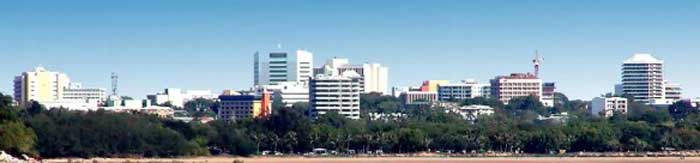
Darwin lies at the northern end of the Stuart Highway and is the capital of the Northern Territory, informally known as the Top End, and it is named after the English naturalist Charles Darwin.
Main reason for tourists visiting Darwin is to see crocodiles in the wild, see some Aboriginal culture and to visit the nearby National Parks like Kakadu, Litchfield and Katherine Gorge / Nitmiluk.
In between people entertain themselves with a city tour or a visit to Mindil Beach Markets.
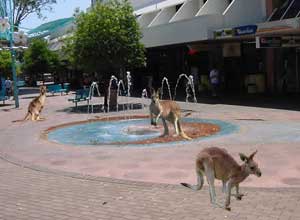
Smith St. mall in Darwin city centre
Nowadays it is a modern city but not so long ago it was still a large outback town with, due to the hot climate, the highest beerconsumption of any city in the world. It is very cosmopolitan though there are no ghettos of certain nationalities like in some of the bigger cities and the international mix of people becomes evident at the many markets in Darwin where you can find cheap eats from almost any country you can think of. The city is also surrounded by beautiful beaches and enjoys spectacular sunsets. Within a few hours drive of Darwin you find spectacular national parks like Kakadu, Litchfield and many other attractions.
Darwin is known for beer drinking and crocodiles and hardly a day goes by without some news on crocs in the local paper, though most crocodile attacks seem to occur on locals that ignore the basic safety rules. Luckily at TIO Insurance you can get crocodile insurance.
Darwin has a compact city centre but a drive out
to the suburbs can be up to 20 km. as the city is built around
the big international airport, also the main police station and
hospital are in the most remote corners of the city.
Darwin's climate has only two seasons, wet and dry. During the
dry there won't be a drop of rain for half a year and temperatures
are pleasant, especially at night. During the wet the landscape
makes a rapid change from brown to green and there are spectacular
lightning storms that attract photographers from all over the
world. If you visit Darwin in the wet you will find that it is
less crowded, easier to find accommodation and the rains most
of the time only consist of a late afternoon downpour.
This city is the main arrival and departure hub for all those
that want to see Kakadu, Litchfield and other Top End attractions.
Darwin's population is fairly transient and it is a relatively
new city as it was virtually wiped out by cyclone
Tracy in 1974 and had to be almost completely rebuilt, though
some of the old sandstone buildings survived.
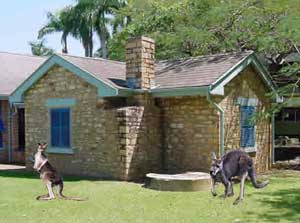
Lyon's cottage, the old Telegraph Residence
In the early days of Australia the British were
worried the French or Dutch would make themselves at home in the
north so it was decided that the Northern Territory needed a settlement.
But with the heat, cyclones and a malaria outbreak, early settlers
found it hard going trying to establish themselves here and from
1824 onwards several attempts were made and later abandoned until
finally in 1869 Darwin was founded. It was first named Palmerston
but as it became unofficially known as Port Darwin it was renamed
in 1911, now the name Palmerston has been assigned to the satellite
city 15km. south of Darwin.
Darwin had a bit of a boomtime when gold was discovered at Pine
Creek in 1871 but the big boom happened in World War Two. In February,
1942, the Japanese air force bombed the city in a Pearl Harbour
style surprise attack. Over 240 Australians lost their lives in
the raids. In all there were 64 raids on the city. Many allied
forces were stationed here to fight the Japs in Asia and the Pacific,
this also led to the Stuart Highway being built that connected
the city with the rest of the country for the first time.
Darwin experienced a setback when on Christmas Day 1974 the city
was hit by cyclone Tracy. Countless houses were totally destroyed,
(only 400 survived intact), 25 ships sunk in the harbour, 35 planes
destroyed at the airport and all communications were cut. After
the cyclone thousands were evacuated to cities in the south and
many never returned.
Since the 1990s the city has started growing more when the army
started moving more soldiers up there from down south, finally
they realized that if Australia were ever to be attacked it would
be by people from the north and not by penguins from the South
Pole.
Another milestone in Darwin's history is the railway, after more
than a hundred years of talking about it the 1420 km. N.T. railway
has finally been built and was completed in October 2003 at a
cost of $ 1.3 billion, the first train arrived in Darwin on January
17, 2004, but Territorians wanting to celebrate at the arrival
of the train were shocked to find it was an alcohol-free event!
Darwin is Australia's hottest city with an annual
rainfall of 1659 mm, this falls between December and May, then
you won't see a drop for half a year. It is hot all year round,
with two distinct seasons, the Wet and the Dry. The Dry Season
temperatures are very pleasant with the mercury going down overnight
to around 18 degrees Celsius and up to about 28 degrees during
the day with no humidity (and no rain). General temperatures for
the Wet Season are 28 to 33 degrees with high humidity.
With Darwin being a very hot place someone in the 1990s tried
to get Darwin to change to the Mexican system of having a siesta
in the heat of the day and then returning to work later. This
idea was discarded as rather than going to sleep at midday, Darwinites
were more likely to go to the pub which would make them pretty
useless for work after a few hours in there.

About Darwin - Accommodation - Tours and what to do - Transport and car hire - Photos - Map

HOME PAGE
Tourist Information
General Information
And Entertainment
ACCOMMODATION IN AUSTRALIA
Bed
& Breakfast
Budget
Accommodation
Backpackers Hostels
Hotels
in Australia
CAR HIRE IN AUSTRALIA
Australia Rental Cars
And
Campervans


TOURS
IN AUSTRALIA
What To Do In Australia
On-line
Shopping
On-line
Dating

About
Australia
Visas For Australia
How
To Get To Australia
How To Get Around
Travel Insurance
Travel Guides
Working
In Australia
Australian
Posters
Survival
Tips
Weather,
When To Go

Use of
this website constitutes acceptance of the User Agreement for this website
Contact us |
Advertise on this site
| Link to this site |Add
your photos or stories to this site |
Webmasters | Affiliates