 Accommodation | International
Flights | Domestic
Flights | Tours
| Travel
Insurance | Car
Hire | Visas
| Shopping
| Dating
| Humour
Accommodation | International
Flights | Domestic
Flights | Tours
| Travel
Insurance | Car
Hire | Visas
| Shopping
| Dating
| Humour
About Melbourne - Accommodation - Tours & what to do - Transport & car hire - Photos - Street map
Melbourne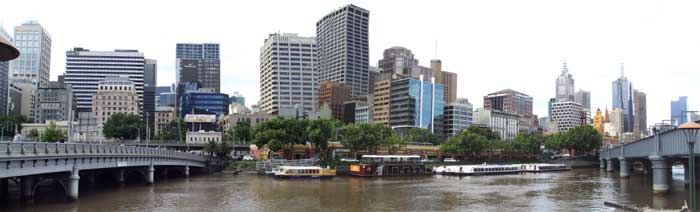
Melbourne city centre and the Yarra river.
Melbourne is Australia's second largest city populated by nearly 4 million Melburnians and it is the capital of the state of Victoria which is also known as the Garden State because of its many parks.
Melbourne is known for its gardens, parks, Victorian buildings, culture and museums, its multicultural population, great shopping and thriving cafe scene.
Although Melbourne does not have such world famous landmarks as Sydney with its bridge and Operahouse, Melbourne has a similar layout as it is also built around a harbour, Port Philip Bay, with the Yarra river further dividing the city in two halves.
The centre of the city, also known as the Central Business District or CBD, sits on the north bank of the river.
The city is named after Lord Melbourne who was the British Prime Minister at the time the city was established.
Melbourne is a vibrant modern city which has attractions for everyone, a thriving art and theatre scene with many galleries and museums, great shopping, cultural activities, world class restaurant and big sporting events such as cricket, football, tennis, Grand Prix and the annual Melbourne Cup that stops the entire country.
Melbourne is a very cosmopolitan city and has the largest
Italian community outside Italy and the third largest Greek community
outside Greece so you can be assured you can find a decent cup of coffee
here ( which can be near impossible in some of the more remote parts
of Australia).
In the city centre there are lanes full of groovy cafes where tourists
mingle with office workers and enjoy an amazing array of excelent food
and drinks.
Being a place for arts and rich culture, Melbourne is also a home for
casino lovers who want to try their luck on casino games. Here you can
find a hotel casino or Crown Casino where you can enjoy it's relaxing
ambiance.
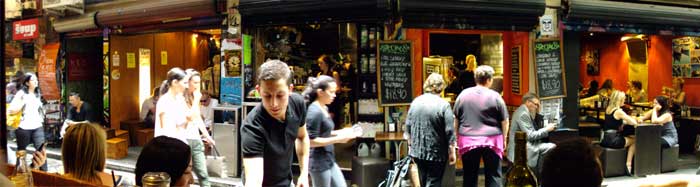
Groovy cafes with excellent food in Melbourne's city centre.
In Melbourne the old and new world live side by side, historic
sandstone Victorian era buildings stand next to glass and steel
highrises.
The city is well endowed with museums and you can learn lots about
Australia and its history here.
There are also over a hundred galleries showing off Melbourne's
thriving art scene.
But Melbourne does not only have attractions in the city, the
area around Melbourne also has many sights worth exploring!
The Dandenongs on the east side are a beautiful forested area
only a short drive from Melbourne city centre with lovely villages,
charming B&B accommodations, art galleries and William Rickett's
Sanctuary.
Only a little bit furher out is Marysville where you find Bruno's
Art and Sculpture Garden.
On the north east side of Melbourne lies Hanging Rock, an eerie
place famous from Peter Weir's book and movie.
To the south of Melbourne is the Mornington Peninsula with beautiful
coastal drives, art galleries, wineries and beaches.
To the west of Melbourne lies the Great Ocean Road, a spectacular
stretch of coastline with towering limestone cliff and nice coastal
towns with some great accommodation.
While having a bit of a reputation for not always real glorious
weather, Melbourne consistently rates as one of the most livable
cities inthe world!
Melbourne was rated as the best city in the world to call home in the
London based Economist Intelligence Unit (EIU)'s survey in 2002. In
2005 it still ranked nr. 2, and in the latest 2010 results it still
had a number 3 position out of 130 cities surveyed worldwide! In 2012
it ranked nr. 1 again as the world's most liveable city!
Also, despite Sydney being the home of the annual Gay Mardi Gras,
the gay.com website declared Melbourne the No. 2 place to visit
on a list of top 10 international destinations beause of the city's
bars, theatres, cuisine, parks, skyline and gay-friendly attitude.
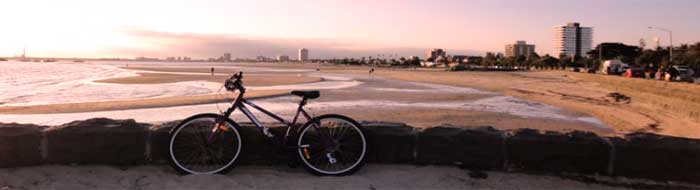
Ride your bike along Melbourne's beaches and enjoy the sunset
Melbourne has 11 km. of coastline with beaches right near the
city centre, the shoreline of Port Phillip Bay includes the suburbs
of Port Melbourne, Albert Park, Middle Park and the most famous
of all, St. Kilda, which has cafes and pubs such as The Esplanade
Hotel, fondly known locally as The Espy.
There are numerous walks to be enjoyed in this area and it is
an ideal area for cycling with many good bicycle paths. Rollerblading
and jogging along the Esplanade are also popular activities.
From Port Melbourne you can catch the ferry to Tasmania or watch
the big cruise ships come in. Piers, pubs and people watching
is one of the tourism industry slogans that sums up the area pretty
good. It is easy to find your way around Melbourne as the city
is laid out in a grid system but if you're driving watch out for
the trams.
The centre of the city is the Bourke Street Mall which is situated
between Swanston Street and Elizabeth Street, running in a north
south direction, Bourke Street and Collins Street are the main
roads running west to east.
There is a free tram that does a loop around the central city
area and stops at all the major tourist attractions such as museums
and Victoria's Markets.
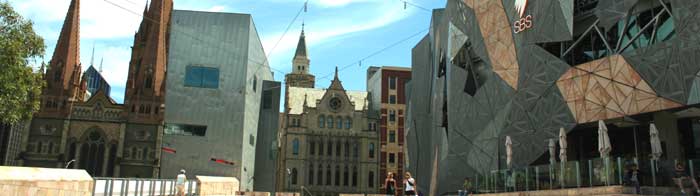
Old and new stand side by side in Melbourne, the contrast of old
stone buildings and churches, and the modern Federation Square
building
Melbourne is an international cultural centre, with cultural
endeavours spanning major events and festivals, drama, musicals,
comedy, music, art, architecture, literature, film and television.
It was the second city after Edinburgh to be named a UNESCO City
of Literature.
The city celebrates a wide variety of annual cultural events and
festivals of all types, including the Melbourne International
Arts Festival, Melbourne International Film Festival, Melbourne
International Comedy Festival and the Melbourne Fringe Festival.
The Australian Ballet is based in Melbourne, as is the Melbourne
Symphony Orchestra. Melbourne is the second home of Opera Australia
after it merged with 'Victoria State Opera' in 1996. The Victorian
Opera had its inaugural season in 2006 and operates out of various
venues in Melbourne.
Notable theatres and performance venues include: The Victorian
Arts Centre (which includes the State Theatre, Hamer Hall, the
Playhouse and the fairfax Studio), Melbourne Recital Centre, Sidney
Myer Music Bowl, Princess Theatre, Regent Theatre, Forum Theatre,
Palace Theatre, Comedy Theatre, Athenaeum Theatre, Her Majesty's
Theatre, Capitol Theatre, Palais Theatre and the Australian Centre
for Contemporary Art.
There are more than 100 galleries in Melbourne, including Australia’s
oldest and largest art gallery, the National Gallery of Victoria.
Sports fans can find plenty of excitement here.
Melbourne hosted the 1956 Summer Olympics games which were the
first Olympic Games ever held in the southern hemisphere, and
also the 2006 Commonwealth Games.
Melbourne is home to three major annual international sporting
events: the Australian Open (one of the four Grand Slam tennis
tournaments), the Melbourne Cup (horse racing), and the Australian
Grand Prix (Formula One).
The city is home to the National Sports Museum.
Australian rules football and cricket are the most popular sports
in Melbourne and also the spiritual home of these two sports in
Australia and both are mostly played in the same stadia in the
city and its suburbs. The first ever official cricket Test match
was played at the Melbourne Cricket Ground in March 1877 and the
Melbourne Cricket Ground is the largest cricket ground in the
world. The first Australian rules football matches were played
in Melbourne in 1859 and the Australian Football League is headquartered
at Docklands Stadium. Nine of its teams are based in the Melbourne
metropolitan area and the five Melbourne AFL matches per week
attract an average 40,000 people per game. Additionally, the city
annually hosts the AFL Grand Final.
A short history of Melbourne:
Melbourne started out in 1835 as a large plot of
land bought from local Aborigines of the Dutigalla tribe in exchange
for flour, tools and clothing by John Batman ( no relation to
the lifesaver in the movies).
This was the second attempt at settlement, it had been abandoned
by the first settlers who had arrived in 1803 and then departed
to Tasmania after staying for less than one year.
By 1851 the population had already increased to 80 000 people and six million sheep were grazing the surrounding country, and the place that had so far been considered part of New South Wales, was now officially declared as the British colony Victoria. It became the largest and richest settlement in Australia as a result of its proximity to the vast goldfields of Ballarat and Bendigo and a large number of gracious homes and commercial buildings were built that can stil be admired today. In 2004 the Royal Exhibitions Buildings and Carlton Gardens were placed under World Heritage listing in recognicition of European settlement as part of Australia's cultura heritage.
The discovery of gold in November 1851 made the town boom and by 1854 the colony's population had grown from 80 000 to 300 000, in 1856 more than 86 tonnes of gold was mined. This established Melbourne as Australia's main financial centre. It was a very prosperous city until the Great Depression in the late 1880s.
At the time of Australia's federation on 1 January
1901, Melbourne became the temporary seat of government of the
federation. The first federal parliament was convened on 9 May
1901 in the Royal Exhibition Building, where it was located until
1927, when it was moved to Canberra.
Melbourne and Sydney both wanted to be the seat of Government
and after years of arguing about it the solution was to build
a new city in the middle of nowhere, which became Canberra.
The Governor-General of Australia resided at Government House
in Melbourne until 1930 and many major national institutions remained
in Melbourne well into the twentieth century.
Flinders Street Station was the world's busiest passenger station
in 1927 and Melbourne's tram network overtook Sydney's to become
the world's largest in the 1940s.

About Melbourne - Accommodation - Tours & what to do - Transport & car hire - Photos - Street map

HOME PAGE
Tourist Information
General Information
And Entertainment
ACCOMMODATION IN AUSTRALIA
Bed
& Breakfast
Budget
Accommodation
Backpackers Hostels
Hotels
in Australia
CAR HIRE IN AUSTRALIA
Australia Rental Cars
And
Campervans


TOURS
IN AUSTRALIA
What To Do In Australia
On-line
Shopping
On-line
Dating

About
Australia
Visas For Australia
How
To Get To Australia
How To Get Around
Travel Insurance
Travel Guides
Working
In Australia
Australian
Posters
Survival
Tips
Weather,
When To Go

Use of
this website constitutes acceptance of the User Agreement for this website
Contact us |
Advertise on this site
| Link to this site |Add
your photos or stories to this site |
Webmasters | Affiliates