 Accommodation | International
Flights | Domestic
Flights | Tours
| Travel
Insurance | Car
Hire | Visas
| Shopping
| Dating
| Humour
Accommodation | International
Flights | Domestic
Flights | Tours
| Travel
Insurance | Car
Hire | Visas
| Shopping
| Dating
| Humour
About Sydney - Accommodation - Tours & what to do - Transport & car hire - Photos - Street map
Sydney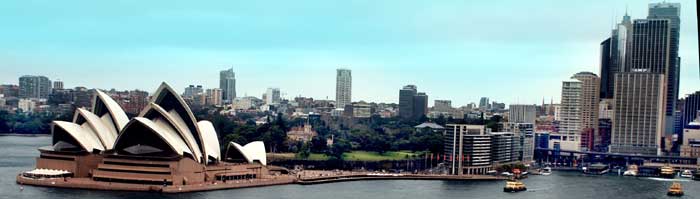
Sydney, the capital of New South Wales, is Australia's largest and most famous city and well known for its landmarks; the Opera House, the Harbour Bridge, Bondi Beach, and as the venue for the 2000 Olympics, the annual Gay and Lesbian Mardi Gras, and the Newyears Eve fireworks from the bridge.
The city offers a huge range of attractions to the many visitors that land here each year and even has excellent beaches, most famous of them all Bondi and Manly. Also it has a few National Parks bordering the city so if you want to escape the city the bush is never more than an hour or so away.
To the west of the city lie the Blue Mountains and a little further inland you will find the Hunter Valley, famous for its wine growing and tasting.
Sydney offers something of interest to everyone, from history to a bustling nightlife to nature based activities and general sight-seeing.
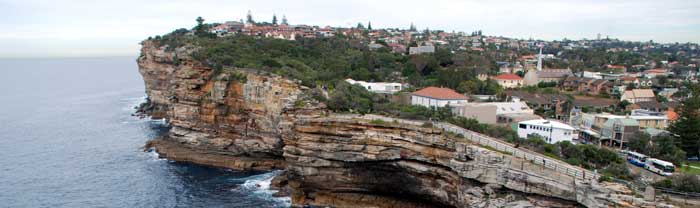
Sydney is built along a spectacular coastline of cliffs and beaches
Sydney started out as a colony of prisoners in 1788
when Arthur Philip landed at Sydney Cove with a few hundred prisoners
and has since grown into a sprawling metropolis of around 4 million
people.
The current location of Sydney was an improvisation by Arthur Philip,
his instructions had been to set up a penal colony with his prisoners
in Botany Bay, an inlet a bit to the south, chosen by James Cook
but as he deemed this one unsuitable sailed a bit further up the
coast until he reached what was then known as Port Jackson.
At the time there were about 3000 Aborigines living around the area
and it took only a few months for the first Aborigine to be killed,
soon to be followed by the spearing of two convicts at Rushcutters
Bay.
A goldrush hit Sydney in 1851 and people left the city in droves,
in the following years thousands of gold seekers from all over the
world passed through Sydney to try their luck on the gold fields.
Nowadays Sydney has spread all around the huge natural
harbour, the northern and southern side connected with a bridge
and a tunnel. Many people also use the ferries that leave from Circular
Quay to the north shore.
Sydney is also the second best place to lose your passport in Australia,
here you will find almost as many consulates as in Canberra.
It must be a good life in Sydney, the London based Economist Intelligence Unit (EIU)'s survey in 2005 ranks Sydney nr. 7 out of 130 cities surveyed worldwide. The EIU assessed the level of hardship for expatriates in the 130 cities, using 12 factors including housing, education, recreational activities, health, climate and terrorism.
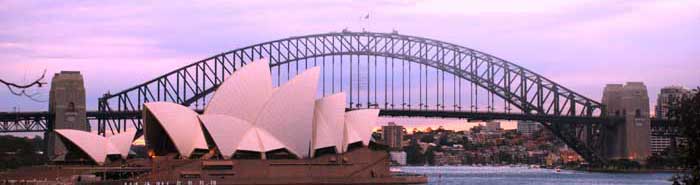
Two of the most famous landmarks together in one shot;
The Opera House and the harbour bridge at sunset
A visit to Sydney simply can not be complete without a visit
to the Opera House, Sydney's most famous landmark. It has an interesting
history; a design competition in 1955 produced 233 entries but it was
Danish architect Joern Utzon who won the job though he never finished
it as he quit in 1966.
He had run into huge arguments with the builders who had considerable
trouble to convert his ideas from a design on paper in to the real
thing, and he was pushed out by Sir Davis Hughes who downgraded
his role in the project and with held payment of his fees.
Construction took far more time and money than expected and ran
from 1959 till 1973 when it was officially opened by Queen Elizabeth
II . The original $7 million budget had blown out to a whopping
$102 million and a team of Aussie architects were left to finish
the interior design after Utzon quit, by then it was realized that
though it looks nice from the outside it is a bit cramped inside.
Utzon left the country and passed away in 2008, and had never returned
to see his creation.
In June 2007 the Sydney Opera House gained World Heritage Listing,
joining more than 800 other sites including the Taj Mahal, the Statue
of Liberty, the Great Wall of China and Egypt's pyramids.


Buy
this Poster at AllPosters.com
or see more posters of Sydney here

About Sydney - Accommodation - Tours & what to do - Transport - Photos - Street map


HOME PAGE
Tourist Information
General Information
And Entertainment
ACCOMMODATION IN AUSTRALIA
Bed
& Breakfast
Budget
Accommodation
Backpackers Hostels
Hotels
in Australia
CAR HIRE IN AUSTRALIA
Australia Rental Cars
And
Campervans


TOURS
IN AUSTRALIA
What To Do In Australia
On-line
Shopping
On-line
Dating

About
Australia
Visas For Australia
How
To Get To Australia
How To Get Around
Travel Insurance
Travel Guides
Working
In Australia
Australian
Posters
Survival
Tips
Weather,
When To Go

Use of
this website constitutes acceptance of the User Agreement for this website
Contact us |
Advertise on this site
| Link to this site |Add
your photos or stories to this site |
Webmasters | Affiliates