 Accommodation | International
Flights | Domestic
Flights | Tours
| Travel
Insurance | Car
Hire | Visas
| Shopping
| Dating
| Humour
Accommodation | International
Flights | Domestic
Flights | Tours
| Travel
Insurance | Car
Hire | Visas
| Shopping
| Dating
| Humour
About Cairns Highlands - Accommodation - Tours & what to do - Transport & car hire - Photos - Map
Atherton Tablelands / Cairns Highlands
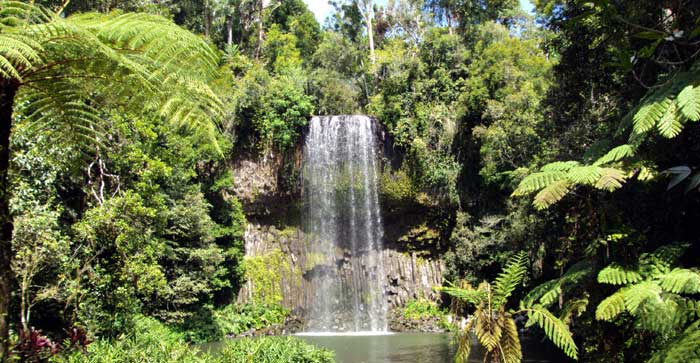
The Millaa Millaa Falls, one of the many spectacular waterfalls in the Cairns Highlands
The Atherton Tablelands, also known as the Cairns Highlands, is located west of Cairns, but despite being at a sub-tropical latitude its elevation means that the climate here is pleasantly cool when the coast is hot during the summer, and it can get frosty at night in the winter.
This area is popular with tourists and local weekend trippers, attractions include beautiful waterfalls, patches of rainforest, hiking tracks around lakes, wildlife that includes the platypus, tree kangaroo and the cassowary, tropical fruitwineries, amazing huge strangler fig trees, historic villages and a friendly laid back population.
The Cairns Highlands are a fertile plateau which is part of the Great Dividing Range, a mountain range that runs along the coast of Queensland. Although the area has no sharply defined boundaries it is considered to be around 32,000 km² in size and incorporates the towns of Atherton, Dimbulah, Herberton, Kairi, Kuranda, Mareeba, Malanda, Millaa Millaa, Mutchilba, Ravenshoe, Tinaroo, Tolga, Walkamin and the most famous of all; Yungaburra.
The fertile volcanic soil and high elevation of this
area that ranges from 600 to 900 metres and they provide excellent
conditions for agriculture and dairy farming, especially Malanda
is famous for its cheese, milk and other dairy products.
The area was originally explored for its mining potential and deposits
of tin and some gold were found, but the only remains of this industry
nowadays are found further to the east in towns like Herberton and
Irvinebank. In 2006, the Atherton Tableland region was devastated
by the Category 4 Cyclone Larry but you will see little damage from
this today,although the Giant Red Cedar Tree is no longer there
as this enormous old tree fell over in the strong winds.
Cyclones normally weaken when the reach the coast but this one was
most unusual and kept its strength as it went further inland and
many of the Tableland towns and the Peeramon Pub sustained severe
damage.
For tourists the area around Yungaburra holds most attractions,
being close to the giant fig trees and the lakes and forests.
Below are some of the main towns of the Atherton Tablelands, other
attractions and localities like the lakes are described on our Tours
and Things to do page.
Click this banner to compare prices of a wide range of Cairns Highlands accommodation from holiday homes to motels:

Atherton
This is the town that this whole area was named after,
it is now a thriving business centre for the farming district.
Although the Atherton area was first explored by JV Mulligan in
1875 it received its name from John Atherton who settled near here
in 1877 and was the first to find tin deposits in North Queensland,
which led to a big rush of miners.
Some time later the building of a road through the Tableland caused
a second rush, this time timber was the target.
The rolling green hills with dairy cows that you see now used to
be covered in rainforests filled with huge trees like red cedar,
kauri, maple, black bean, walnut, white beech and red tulip oak.
Before Atherton had developed, there was already a full-blown Chinatown.
The Chinese had moved from the Palmer River Goldfields when the
rush there was over. They were the pioneers of agriculture and grew
80% of crop production on the Tablelands. After the crops, they
turned to dairying. As the population of Chinatown increased, small
shops appeared, wells were sunk to supply water, there were cooks,
herbalists, doctors and merchants etc. The rough straw huts were
replaced by sawn timber houses with verandahs and corrugated iron
roofs. By 1909, Chinatown had become the largest concentration of
Chinese on the Tablelands with a population on 1100. Today, you
can still find the Hou Wang Temple that remains as one of the few
reminders of the former Chinese population of the Atherton Tablelands.
World War 2 changed Atherton when the population from the coast
found this a safer place, and the army set up their facilities in
this area. Crops grown in and around Atherton include banana, sugarcane,
corn/maize, avocados, strawberries, macadamia nuts and mangoes and
citrus. Tobacco was also grown for many years.
Average temperatures around here vary from 17–35 °C in
summer tor 5–22 °C in winter.
Malanda
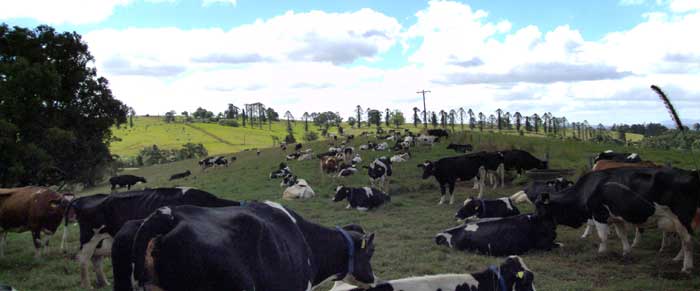
Malanda is famous for its dairy industry of milk and cheese products
Malanda is a medium-sized town that is nowadays well known for
its dairy industry of milk and cheese, but it was first developed
in the 1880s when the discovery of tin and copper at Herberton saw
a steady stream of miners and engineers moving over the mountains
from the coast. In 1886 a decision was made to bring a railway into
the area but the problems of construction were enormous and it did
not reach Malanda until 1911 and closed again in 1964.
The town Malanda has a few attractions worth visiting such as;
- the dairy museum
- the Malanda Falls, compared to other water falls in the area not
very spectacular but you can go there for a crocodile-free swim
and there is supposed platypus in there as well.
- the Malanda Environmental Park — just opposite the Malanda
Falls the park offers a short walk through the rainforest and an
opportunity to see a wide range of rainforest trees.
- the Majestic Theatre is said to be the oldest continually operating
cinema in Australia and has potato sack seating.
- the Malanda Hotel has a grand ballroom and beautiful timber staircase
and is claimed to be the largest wooden structure in Australia,
there is accommodation available upstairs and meals and drinks downstairs
in the bar.
- the Malanda Art Trail, starting at the town library.
Kuranda
Kuranda is a thriving tourist town of around 650 people that swells
to a few thousand every morning when the tourists roll in on buses,
the historic train and the Skyrail, to see the famous markets. It
is located 25 kilometres from Cairns at an elevation of 330 metres
and is surrounded by rainforest so it has a very pleasant climate.
Before the European settlers arrived the rainforests around Kuranda
had been home to the Djabugay people for over 10,000 years. Europeans
started exploring the area in the nineteenth century and Kuranda
was settled in 1885.
Construction of the now famous railway from Cairns started in 1887
and the line reached Kuranda in 1891.
The current railway station where tourists arrive now was built
in 1915.
Although coffee was grown around Kuranda in the early twentieth
century, timber was the town's primary industry for years, throughout
the '60s and '70s Kuranda was popular with alternative lifestylers
and nowadays tourism is driving the economy.
Attractions in the town include several markets, consisting of a
range of arts and crafts stalls as well as cafes and restaurants.
Kuranda is a major centre for opals and didgeridoos. It was also
the first home of the Tjapukai Indigenous Dance Theatre, established
by former New Yorkers Judy and Don Freeman, together with indigenous
dancer and actor David Hudson.
The theatre was later relocated and now sits next to the Skyrail
base station at Caravonica near Cairns.
Kuranda is also home to a bird park, butterfly sanctuary, a bat
rehabilitation centre, snake and venom park and koala sanctuary.
As the town is surrounded by rainforest there are numerous walks
and lookouts.
Most tourists arrive in the town on the Kuranda
Scenic Railway from Cairns, the Skyrail
gondola cableway, or by coach over the Kuranda Range
road.
Millaa Millaa
 |
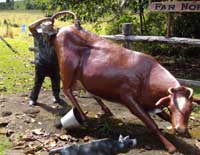 |
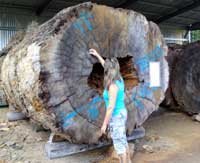
The town of Millaa Millaa is nearby the stunning Millaa Millaa waterfall that you see at the top of this page, and also hosts some other interesting displays, like the red cedar log above that shows you what giant trees once covered this landscape of green hills and dairy cows , and also the interesting artwork on the right, what's this guy doing?
Yungaburra
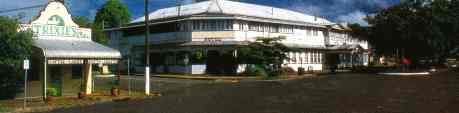
The classic old Lake Eecham Hotel in the centre of Yungaburra
Yungaburra is a charming historic little town of only a 1000 or
so people, more pleasant and attractive to tourists than some other
towns that are more business centres for the surrounding farming
district.
At an elevation of 750 metres above sea level it has a pleasant
cool climate in summer but can have cold nights in the winter time,
fire places and hot spas are standard equipment in many rooms here,
making this a popular place for romantic weekends away for the Cairns
locals too.
The Yungaburra Markets, held on the fourth weekend of each month, are one of the largest in Far North Queensland, and each year around the end of October, Yungaburra holds the two-day Yungaburra Folk Festival, featuring concerts from Australian (and sometimes international) folk musicians.
The town got started off in the mining boom days but nowadays its economy today revolves around tourism, and the town contains a primary school, post office, library/telecentre and a range of businesses and services for the use of residents and visitors. Yungaburra has 18 Heritage Listed buildings, and is the largest National Trust village in Queensland.
The landscape around Yungaburra has been shaped by millennia of volcanic activity. The most recent eruptions were over 12000 years ago and created some interesting geological features such as Mount Hypipamee Crater, Lake Eacham and Lake Barrine, Tinaroo Dam is a man-made dam in the Barron River, now used by water skiers and for recreation.
There are a number of places to dine, from Keddies Takeaway to
fine dining to Nicks Restaurant. Nick's is a German style restaurant/bar
that also used to do yodelling performances, not sure if they still
happen, good for homesick Swiss tourists but probably not what most
people come for to this region. Not sure how good the food is as
we walked out not being able to get any service after 15 minutes,
most times we stay in Yungaburra we get cheese and wine at the shop
anyway to make the most out of the rooms with fireplaces and spas.
Near Nick's restaurant is a platform built on the river where you
can spot platypus swimming around at dusk.
About Cairns Highlands - Accommodation - Tours & what to do - Transport & car hire - Photos - Map

HOME PAGE
Tourist Information
General Information
And Entertainment
ACCOMMODATION IN AUSTRALIA
Bed
& Breakfast
Budget
Accommodation
Backpackers Hostels
Hotels
in Australia
CAR HIRE IN AUSTRALIA
Australia Rental Cars
And
Campervans


TOURS
IN AUSTRALIA
What To Do In Australia
On-line
Shopping
On-line
Dating

About
Australia
Visas For Australia
How
To Get To Australia
How To Get Around
Travel Insurance
Travel Guides
Working
In Australia
Australian
Posters
Survival
Tips
Weather,
When To Go

Use of
this website constitutes acceptance of the User Agreement for this website
Contact us |
Advertise on this site
| Link to this site |Add
your photos or stories to this site |
Webmasters | Affiliates