 Accommodation | International
Flights | Domestic
Flights | Tours
| Travel
Insurance | Car
Hire | Visas
| Shopping
| Dating
| Humour
Accommodation | International
Flights | Domestic
Flights | Tours
| Travel
Insurance | Car
Hire | Visas
| Shopping
| Dating
| Humour
About Byron Bay - Accommodation - Tours & what to do - Transport & car hire - Photos - Street map
Byron Bay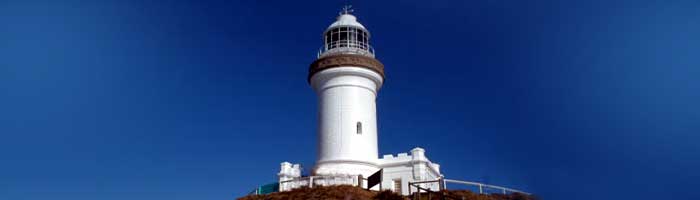
Byron Bay is located 800 km north of Sydney and 170 km south of Brisbane, and it has made an interesting transition from whaling industry to hippie haven to a trendy modern holiday destination, populated by alternative lifestylers and cashed up crowd that got tired of city living, like Elle Macpherson, Olivia Newton John and Crocodile Dundee.
The lighthouse on Cape Byron is the first place in Australia to see the new day, it stands on the most easterly point of Australia’s mainland, and is a great place to watch the sunrise.
Byron Bay's main attractions are the beach and
its waves, it is a great surfing spot, and its cafes and generally
just hanging out enjoying the scene. During summer months the
town gets a bit crowded and congested and you should book your
accommodation and tours well in advance. And if you plan to join
the Newyears Eve celebrations here you need to plan even further
ahead, the police usually blocks off the main road to stop people
overcrowding the town!
Finding your way around is pretty easy, just about everything
is situated along or just off the main street Jonson Street; shops,
cafes, restaurants and accommodation, and the main beach is also
reached along this street. Beaches run all the way from here up
to the Gold Coast for about 50km.
There is also a nudist beach here named Tyagarah Beach, and you
can spot dolphins right near the beach and also whales during
the migrating season as they pass Cape Byron around June/July
and September/November.
The local population likes their town just the way it is, and
when Club Med and McDonald's wanted to move in public pressure
and the overwhelmingly green Byron Shire Council made it very
clear they were not welcome and succesfully kept them out.
Byron Bay used to be known as 'cavaba' by the traditional
owners, the Banjalang Aboriginal tribe but, like most places along
the east coast, was renamed by Captain James Cook on his journey
up the coast in 1770, after Vice-Admiral John Byron who was the
grandfather of the famous 19th century poet, Lord Byron.
After Cook had passed it took until 1928 when Captain H.J. Rous
arrived and gave the bay to the north of Cape Byron the name Byron
Bay. In the 1840s timber cutters arrived to cut down the huge
red cedars in the hinterland which kept them busy until the 1850s.
The actual Bay was slowly settled by Europeans starting from 1869
and settlers were extremely happy to discover that the rich soil
was perfect for growing bananas, pineapples, corn, potatoes, basically
anything. By 1886 the town of Byron Bay was now starting to happen
and shops, hotels, pubs, a jetty and a post office were built
and in 1890 the town got connected to the outside world by railway.
Other milestones in the town's history include 1901 when the lighthouse
was built and 1962 when they stopped whaling off the Byron coast.
Nowadays the local economy is tourism and surfboard manufacturing.
Byron Bay weather today |
Byron Bay weather forecast |

HOME PAGE
Tourist Information
General Information
And Entertainment
ACCOMMODATION IN AUSTRALIA
Bed
& Breakfast
Budget
Accommodation
Backpackers Hostels
Hotels
in Australia
CAR HIRE IN AUSTRALIA
Australia Rental Cars
And
Campervans


TOURS
IN AUSTRALIA
What To Do In Australia
On-line
Shopping
On-line
Dating

About
Australia
Visas For Australia
How
To Get To Australia
How To Get Around
Travel Insurance
Travel Guides
Working
In Australia
Australian
Posters
Survival
Tips
Weather,
When To Go

Use of
this website constitutes acceptance of the User Agreement for this website
Contact us |
Advertise on this site
| Link to this site |Add
your photos or stories to this site |
Webmasters | Affiliates