 Accommodation | International
Flights | Domestic
Flights | Tours
| Travel
Insurance | Car
Hire | Visas
| Shopping
| Dating
| Humour
Accommodation | International
Flights | Domestic
Flights | Tours
| Travel
Insurance | Car
Hire | Visas
| Shopping
| Dating
| Humour
Amazing Australian Animals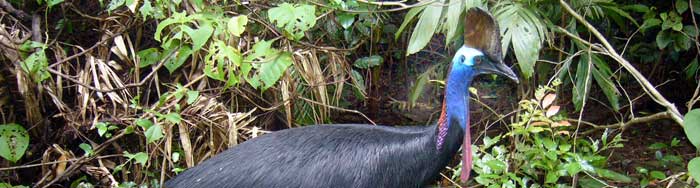
Australia has some pretty amazing animals.
Some hop instead of run, the swans are black and not white, in summer the northern waters are filled with box jellyfish that can kill you in five minutes, the platypus is a mix of a beaver, a duck and is the world's only poisonous mammal, in the trees you will find koalas and treekangaroos, in the rivers there are crocodiles up to five metres and in the rainforests there are birds two metres tall... the list goes on.
This page has all sorts of animals, if your interested in birds click to see the Australian birds page.
Bandicoot
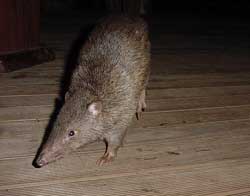
Photo by Rob Lapaer of Rainforest
Hideaway B&B, Cape Tribulation, N.Qld.
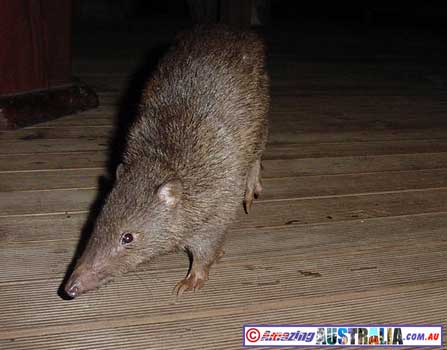
The bandicoot has the shortest gestation period of any animal; it only takes twelve days from mating to giving birth!
Bilby
Originally known as the rabbit-eared bandicoot this poor creature was near extinction when its name change and a push to replace the easterbunny (Australians think rabbits are a pest) with the bilby made it very popular and efforts were made to protect and revive this species. Chocolate companies changed their products from bunnies to bilbies.
Box Jelly Fish
Photo by Katrin Holmsten
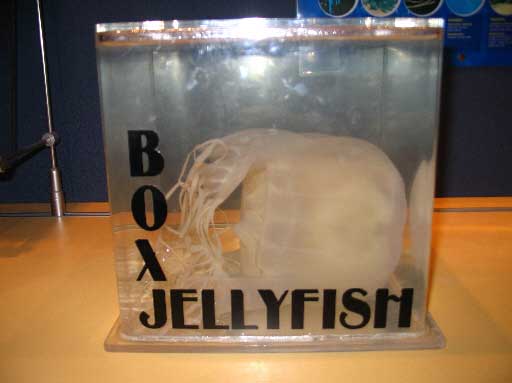
The box jelly fish, also known as sea wasp or stinger, is
claimed to be the world's most venomous marine animal known.
The Box Jellyfish has a four sided shape up to 20 cm long and they may
have up to as many as sixty tentacles up to 3 metres in length.
Their color is pale blue and transparent and they are difficult to see,
and for a long time it was a mystery what was actually causing such excruciating
pain often followed by death, which can occur sometimes within 2 to 3
minutes. More....
Brolga
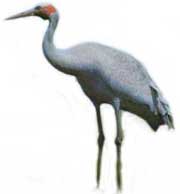
The Brolga is a key figure in Aboriginal mythology or Dreamtime and is a member of the crane family. Stands over a metre tall and is commonly found in the wetland areas of northern and eastern Australia.
Brush turkey
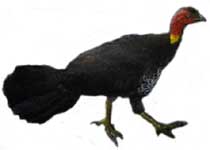
In December 2003 the Gold Coast Bulletin reported that a middle-aged man
was walking along a track in the Burleigh Heads National Park when he
fell into a mating hole of a brush turkey who then approached the man
and tried to bury him in a mating ritual. The man spent some time in the
hole until a passer-by saw him and alerted emergency services. Several
fire crews attended the bizarre scene to pull the man from the hole who
was left shaken but suffering only minor injuries. Queensland Parks and
Wildlife ranger Sergio Norambuena said December was the mating season
for brush turkeys when they build a massive mound or hole that can end
up three metres wide and several metres high to attract the opposite sex
and the mound is later used to incubate the eggs. A week ago signs warning
people of wild turkeys were erected in the national park.
Cassowary
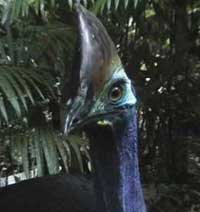
Photo by Rob Lapaer of Rainforest
Hideaway B&B, Cape Tribulation, N.Qld.
Australia's most spectacular bird would have to be the cassowary,
up to two metres tall, covered in coarse black double stranded feathers,
and with brilliant colors of red and blue on its neck and head. This elusive
flightless bird is highly endangered and lives only in the Wet Tropics
area of North Queensland and another patch of remote rainforest high up
on the Cape York peninsula.
The cassowary (Casuarius casuarius johnsonii) has been wandering around
this planet since before the super continent Gondwana broke up....Read
more....
They can also be quite territorial, read
more on cassowary attacks...
Cockatoo
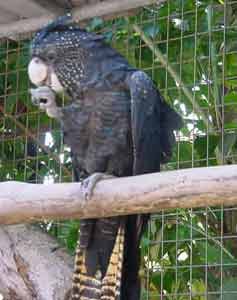
Photo courtesy of www.ourdarwin.com
You would think that a bird as beautiful as the cockatoo
would sing beautiful as well but it produces nothing but a raucous squawk.
They come in a variety of colors, the white (sulphur crested) the most
common one and others like the black palm cockatoo more rare.
This made the news in 2002; Kevin Butler lived in the US with his Aussie
cockatoo Bird as a pet. Kevin was found dead one day in 2002 with multiple
stabwounds and Bird was found dead in the kitchen with a fork in his back
and a leg cut off. Police later charged Daniel Torres with the murder,
having found his DNA in Bird's beak. It turned out that while Daniel tried
to kill Kevin, the Aussie superhero Bird violently pecked at Daniel's
head and clawed at his skin in a desperate effort to save his owner!
Are you a bird expert? Write the cockatoo page for us!
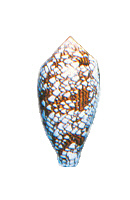
Cone shell
If you thought you were safe on the
beach as long as there are no crocodiles, sharks, stonefish, seawasps
or seasnakes around think again, the cone shells that grow to around
10cm in length can jab a minute harpoon with 1 to 20 radular teeth
penetrating skin to inject venom to immobilise their victim. |
 |
Crocodiles
The crocodile is a prehistoric reptile that has survived
for 200 million years through several ice ages and has seen the dinosaur
come and go. By 1972 crocodiles were hunted close to exctinction for their
skins but nowadays they are protected. Ironically enough their protection
was not a result of environmental awareness but people were being worried
the might disappear as a resource. Nowadays there is no danger of extinction
as their numbers have increased dramatically to the point where many people
are calling for them to be culled to get the numbers down as they now
often stray into territory close to people. In 2003 Territory Parks and
Wildlife officers caught 180 crocodiles ranging from 2.5 to 4 metre in
the 19 traps they manage around Darwin harbour.
Nowadays there is also a thriving crocodile industry, they are farmed
very successfully in farms that maintain small breeding populations, and
raise the hatchlings until they reach around a meter in length. The main
products of crocodile farms are leather and meat.
The reputation of the appetite of crocodiles was dented a bit when early
March 2004 the bodies of two prostitutes were found in the Adelaide River
near Darwin. They had been thrown off a bridge alive but had drowned and
their intact bodies were found by a boatload of croc-spotting tourists
30 hours later.
More on crocodiles....
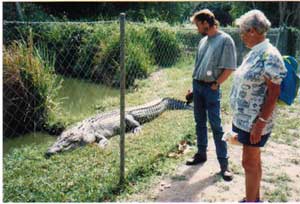
Photo by Rob Lapaer of Rainforest
Hideaway B&B, Cape Tribulation, N.Qld.
One of the most famous crocodiles in Australia's history is Sweetheart. Between September 1978 and July 1979 there was a string of attacks on small aluminium fishing boats in the Finniss River, Northern Territory when a 5.1 metre male crocodile got into the ( for crocs unusual) habit of biting outboard motors and attacking and overturning boats. More on crocodile attacks...
Dingo
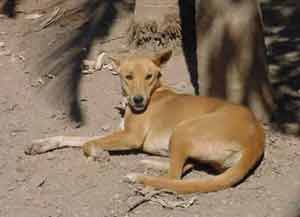
Photo courtesy of www.ourdarwin.com
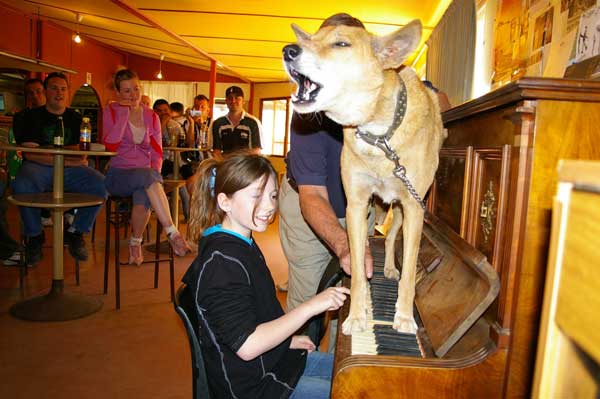
Dinky, the singing and piano playing dingo, lives at Stuart’s
Well Roadhouse, also known as Jim’s Place, 100 km south of Alice
Springs on the Stuart Highway. Whenever the piano is played at Jim's place,
Dinkie jumps up on the piano, plays some four pawed notes and howls along
with the tune.
Dinky has also been added to the Australian version of Trivial Pursuit
so remember this paragraph, it might save you when you're playing this
game with your Australian hosts.
Also sometimes referred to as the native dog, the dingo
is believed to have been brought in by people around 7000 years ago and
has also been blamed for the decline of the Thylacine, or Tasmanian Tiger
on mainland Australia.
Scientists have warned that the dingo will be extinct within 50 years.
Using DNA analysis of the animals, researchers have discovered that crossbreeding
with domestic dogs is wiping out the pure dingo line. 80 per cent of all
wild dingoes in eastern Australia have become hybrids through "introgression",
the flow of genes from one population into another.
Some dingo attacks have made the news headlines over the years by dragging Azaria out of her tent at Ayers Rock that was never seen again and killing a young boy on Fraser Island. This last one cost them dearly as National Park Rangers then picked up their guns and shot several of the cheekiest dingos.
Dugong
Dugong are also called sea cows and are large herbivorous mammals. They live in the tropical northern waters of Australia where they feed on the various algae and sea grasses. Dugongs are a very endangered species and are protected by law but some Aborigines exercise "traditional hunting rights" and still kill and eat some.
Echidna
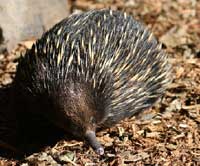
Echidna
Photo by Katrin Holmsten
Info on this one to be added soon, or if you're a wildlife expert write the echidna page for us!
Emu
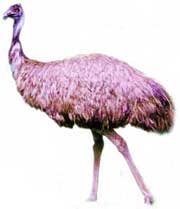
After the ostrich this is the largest bird in the world and it is part of the Australian coat of arms. the emu stands an impressive 1.5 metres high and can weigh up to 55 kilograms. Being flightless, emus have developed strong muscular legs that enable them to walk for thousands of kilometres and run at speeds of up to 50 kilometres per hour. The emu is farmed for its meat and feathers though the meat is a little tough and best eaten thinly sliced.
Photo by Rob Lapaer of Rainforest
Hideaway B&B, Cape Tribulation, N.Qld.
Early 2005 Dr Louis Lefebvre, of Montreal's McGill University, compiled the world's first bird IQ index from 2000 recorded observations. He concluded the smartest birds were crows and falcons and the poor old emu ended up at the other end of the scale as the world's dumbest bird.
Flies
Some of the outback areas can be that infested with flies
that it is necessary to wear a fly-net around the head to stop the flies
from continuously entering every orifice they can find, even the hat with
corks won't help here. The constant waving of hands to scare off flies
is know as "the Australian Salute".
Flies are believed to have been here when Captain Cook arrived but in
much smaller numbers, it was only when Europeans started filling the landscape
with cows and sheep that spread their moist dung around that flies found
a perfect breeding ground that really blew their numbers out of control.
The government has scientists working on a program to introduce dung beetles
to clean up all this crap so there will be less to breed in for the flies
and Australians won't spill their beer while waving their hands around.
If flies annoy you then you might like to consider buying a fly
gun.
Funnelweb Spider
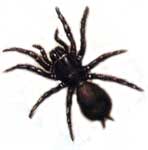
Common on the North Shore of Sydney Harbour this spider
is considered the most venomous spider in the world out of 2000 species
of spiders found in Australia.
In 1998 around 300 people were bitten by this spider but since antivenom
was developed in the early 1980s over 11,000 people have been succesfully
treated with it and nobody has died from a funnel-web bite since, though
there was a case of a suspected funnel-web spider bite in March 1999 when
a northern NSW man died.
The Commonwealth Serum Laboratory produces the antivenom from venom taken
from funnel-webs in the Australian Reptile Park just north of Sydney.
Giant Clam
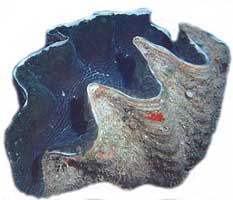
You can see these clams on the Great Barrier Reef when you go snorkelling or scuba diving from Cape Tribulation.
Giant Earth Worm
The Giant Gippsland Earthworm (Megascoloides australis) is the largest species of earthworm in the world with an average length of 1.5m but can grow up to 4 m with a diameter 2 cm. It is estimated they may live at least ten years or more. They inhabit dark blue-grey clay soils associated with creek & river banks in an area roughly bounded by Loch, Korumburra & Warragul. Their status is classed as vulnerable and it is unknown how many would be alive. The Giant Gippsland Earthworm has a pinkish-grey body with a dark purple head. They are often uncovered during digging. Injuries sustained by being dug out of their burrows or direct handling by humans will almost certainly kill them. They are very fragile.
Golden Orb spider
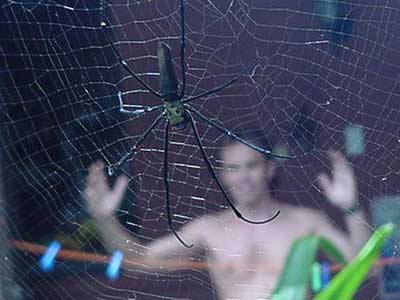
Photo by Rob Lapaer of Rainforest
Hideaway B&B, Cape Tribulation, N.Qld.
Life's not very fair in the world of golden orb spiders,
while the female measures up to ten centimetres across the male is only
a few millimetres in size. While the female sits in the centre of the
web and catches and eats her prey there the males have to sneak in and
steal food hoping not to get caught. Then they get to mate only once and
after that they get eaten!
They are not poisonous to humans and you can watch them in action in this
movie where an Aussie boy got covered in 125of them to get
in the Guinness Book of Records.
Irukandji jellyfish
This jellyfish is only about one to two centimetres in size, but it can put you through agony for days. The sting will not usually kill you, although you will be convinced you are going to die from the extreme pain it causes.
One Irukandji sting that made international headlines was in December 2009 when Best Job in The World winner Ben Southall was only days away from the end of his six-month stint as "caretaker" of Hamilton Island in Queensland and was stung when he jumped off his jet ski.
Kangaroo
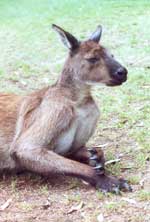
Photo by Lyn Rose
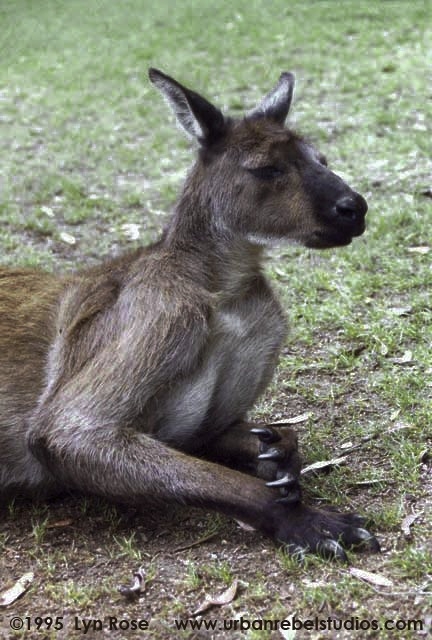
The most famous kangaroo of all times as we all know is
Skippy, even though his TV series only ran until 1971, after more than
three decades he is still world famous.
The kangaroo is part of the national Coat of Arms and there are about
40 million of them estimated to be hopping around the country, some species
endangered, others in almost plague proprtions, overall there are more
kangaroos today than there were when white people first arrived.
Apparently the name 'kangaroo' originated when Captain Cook and his crew
were in Cooktown fixing their ship and discovered this weird hopping animal.
When the local Aborigines were asked what the name of this animal was
they replied something like ' kang-goo-roo' . This was actually "gangurru"
, from the Guugu Yimithirrr language, which is still spoken by the Aboriginal
people in the area around Cooktown.
 Kangaroo Road Sign T-Shirt |
 Kangaroo Sunset Side Print T-Shirt - Double Sided |
 Kangaroos of Australia T-Shirt |
While nowadays you can get a roo burger in many tourist places the consumption of their meat was banned for most of the 20th century. It certainly would have been much better for the Australian environment had people always eaten kangaroos rather than beef as the altering of the landscape by grazing cows has done some serious environmental damage. More info on kangaroos...
Koala
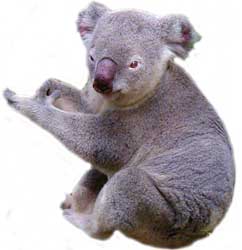
First of all there are NO KOALA BEARS, a koala is a marsupial
and a bear is not so they have no relationship whatsoever !
The koala is a fussy eater and will only eat eucalyptus leaves and only
from 120 of about 700 types of eucalypt trees, about half to one kg. a
day. That was the main reason for a zoo in California last year to get
rid of their koalas, shipping the special leaves in left the zoo with
a $100,000.- a year food bill! To digest this diet of not very nutritious
gum leaves they have, for their size, the longest appendix in the world.
They usually obtain all their water from the leaves but can drink when
they feel the need to. Despite their dopey appearance they turn into ferocious
fighters during mating season. Koala young are known as 'joeys' and only
two centimetres in length at birth, after which they move into their pouch
for 5-6 months and then ride on the mothers back until about a year old.
About 100 000 of them are estimated to be living in Australia nowadays.
Koalas are mostly nocturnal animals, which means that they sleep in the
daytime, and move around and feed at night. The breeding season for koalas
runs roughly from September to March. This is a time of increased activity,
and sound levels increase as males bellow more frequently. Since white
settlement of Australia approximately 80% of the koala’s habitat
has been destroyed. Of the remaining 20% almost none is protected and
most occurs on privately owned land. They live from South Australia along
the east -coast as far north as Magnetic Island. More
info on koalas in Australia...


Koala
Line up
Buy
this Art Print at AllPosters.com
Kookaburra
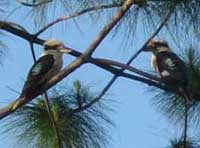
Two kookaburras in a casuarina tree
Australian bird famous for its laughing call, member of the Kingfisher family. Can be spotted throughout coastal Australia particularly in the east and south-west.
Lungfish
The Lungfish has been around for the past 100 million years and lives in the rivers of northern Australia. Lungfish are classed as living fossils and are a protected species. They cleverly survive during the dry season (when there is less oxygen in the water), by breathing in air from the surface of the water with only one lung.
Mad-woman-laughing bird
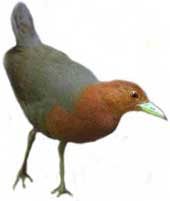
Officially known as the red necked crake, this nocturnal bird produces a call similar to a laughing old witch in a Walt Disney movie.
Mudskipper
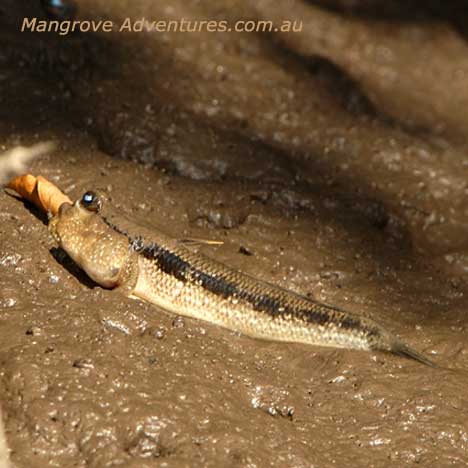
Photo by Mangrove
Adventures
Fish that walk on land? Yes, mudskippers live on the mud flats of Australian mangrove regions. They have small leg-like fins which allow them to walk across the mud, and can even stay out of the water by retaining water within their gills. The mudskipper hunts for food under and above the water (which it can do at the same time due to its large, bulging eyes).
Nudibranches
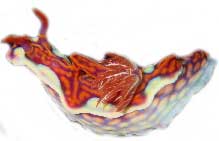
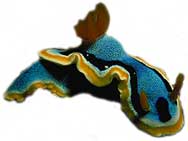
Nudibranches are best described as marine underwater snails, but instead of being protected by a hard shell like normal snails they rely on bright colors to scare off potential attackers ( bright colors often indicate toxicity in nature). The colors are also used as a disguise to blend the animal into the background. Over 3000 species are known to science and they come in a huge variety of spectacular bright colors. More.....
Pigs
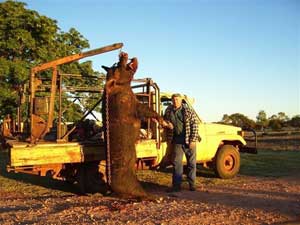
Pigs grow large, but not usually this large....
Often referred to as feral pigs, not native to Australia,
but they have been around for a long time now, and it is not quite clear
where they came from.
Some say Captain Cook put them ashore to multiply so there would be a
food source if they came back again, others think they have been introduced
from New Guinea where they are an important part of diet and culture.
What ever the real story is, there are heaps of them now, and they do
not fit very well in to the Australian eco system.
They dig up nests of sea turtles on the beaches and eat their eggs, in
the rainforest they dig up the soil destroying seedlings and young trees,
and eat the seeds that the native cassowary should eat and disperse, and
everywhere else they generally make a mess of the place.
They also grow in to pretty large boars, and have been known to attack
people.
One pig even ran in to the hospital in Mossman, north Queensland, and
did a lap scaring the hell out of everyone until it crashed through a
window and escaped again.
Platypus
The world's only poisonous mammal. It is also scientifically known as a monotreme; this means having one hole for sex, excretion and egg laying. Is found all along eastern Australia in waterways and while they normally prefer clean water they have even been spotted in increasing numbers in Melbourne's sewers. One was spotted in Cooper Creek in the Daintree in 2003 which was a first for this area, they can be more commonly found near there in the Atherton Tablelands inland from Cairns where the council in Yungaburra had to build a special viewing area to stop people from standing on a narrow bridge creating a safety hazard. They are a rather bizarre animal with their otter-like furry body and webbed duck feet and beak, when the first platypus was prepared by a taxidermist and taken back to England everybody thought it was a practical joke! When you're talking about them remember it is a platypus if there's one but if there's several they become platypi, not platypusses.
Python
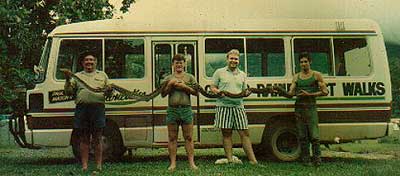
Photo courtesy of Mason's
Tours, Cape Tribulation
The amethystine python can grow up to 8.5 metres, the one above being held by the Masons at Cape Tribulation is "only" 4.5 metres. Pythons are often on the move at night and their skin gives the shine of amethyst in the headlights of your car, hence their name. This is by no means the largest python, in January 2004 villagers in Sumatra caught a python that measured 15 metres and weighed 450 kg.
 |
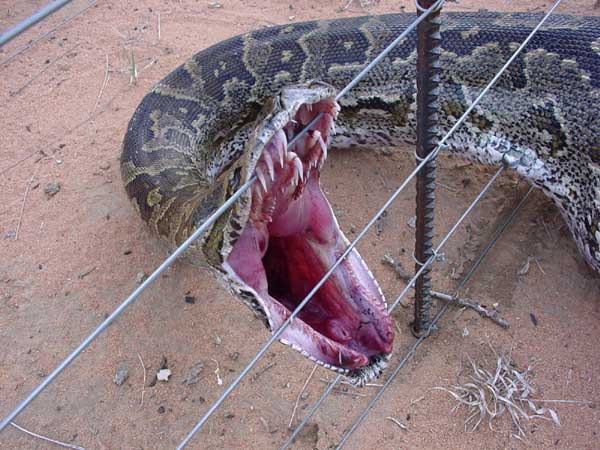 |
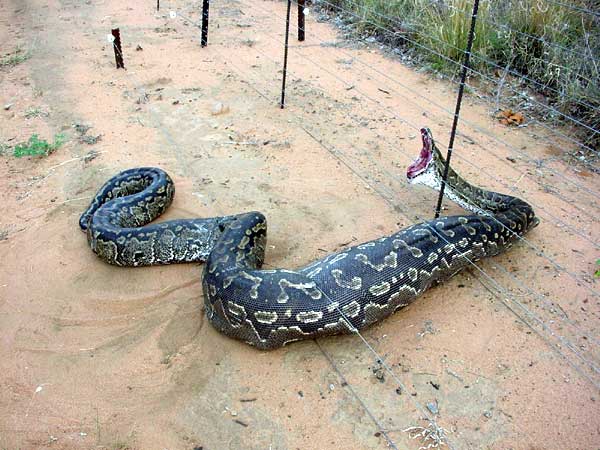
To give you some idea of how big pythons can get, check out these pics of an African rock python, some tourists came across this snake caught in an electric fence, being continually shocked, and getting very angry! The group wondering what to do, decided to divert the current, cut the wire AND let the snake go! (thinking this was the humane thing to do). When the property owner found out he went ballistic, besides being upset about his fence, the snake had been eating lambs in the area, and he'd been trying to catch it for ages. He did not appreciate the help!
 |
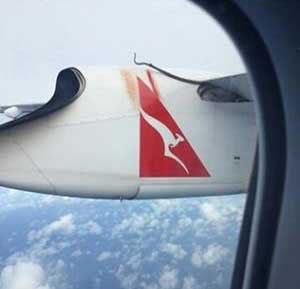 |
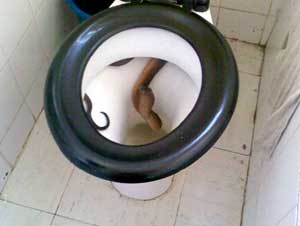
As you see above, pythons and other snakes can be found everywhere in
Australia, in your toilet bowl, or even on the plane!
In January 2013 this python made world headlines in the news when he crawled
aboard a plane in Cairns and en route to New Guinea got a bit cold and
came out of his hiding place. The strong wind made him fly around and
he did not survive the flight and was pronounced dead on arrival.
Quokka
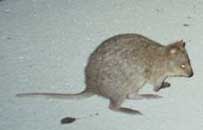
Quokkas are found in only one place; Rottnest Island off Perth.
Redback spider
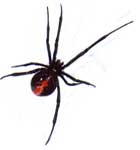
This spider is found all over Australia except in the hot
deserts and coldest mountains. It is closely related to the Black Widow
spider which is the most common source of spider bites in other parts
of the world. Unlike the funnelweb, the redback is not aggressive but
will guard her eggs fiercely or will bite if trapped in clothing or rubbish
being collected.
The bite of the male is considered harmless due to his tiny jaws but the
female's bite can be dangerous to humans but no deaths have occurred since
antivenene was developed in 1956. Symptoms of being bitten are severe
pain, nausea and vomiting, sweating, particularly in the bite area and
muscular weakness.
Like many other spiders the female will often kill and eat the male after
mating.
Two Canadian scientists had some Aussie redback spiders all the way in
Toronto and studied their sex life thoroughly.They found that female redback
spiders enjoy long courtships of nearly two hours, which include activities
like vibrating their webs and rubbing their tummies. If this does not
happen to her liking she'll get in a foul mood and eat the male spider.
However, if her desires are met then she will get so excited that the
eight legged slut will do it with anyone who is around, and although one
male might have spent two hours vibrating her web and rubbing her tummy,
any other male who is hanging around, and often they hang around in clusters,
can have his way with her.After mating she spins up to 8 round balls of
web for her eggs and some of these balls contain as many as 300 eggs that
will hatch in about 2 weeks time and the spiderlings will moult several
times as they grow to full size.
The web is built in dry sheltered areas such as under rocks, in logs,
junk-piles, sheds and dunnies. It consists of a funnel shaped retreat
area with sticky threads running vertically to ground attachments.
This spider has in the last few years been reported in countries as far
away as Belgium and Japan, probably having hitched rides in export goods.
Sea Snakes
The sea snake inhabits the waters of northern Australia and there are 31 species of sea snake, all of them dangerous to humans, but relatively few of these bites cause any significant injury because of the extremely tiny fangs. They contain neurotoxins and an adult sea snake may carry enough venom to kill approximately three adult people. Deaths that have been documented occurred among fishermen who ran into their nests. Sea snakes can not breathe under water but some species feed and rest in water up to 100 metres deep, and can remain submerged for up to two hours. They bear their young on shore, and spend the remainder of their lives in the ocean looking for food like fish and eel. They are very shy and not aggressive by nature, a few will approach divers, apparently out of curiosity, and will even twine themselves around an arm or a leg, but will not bite unless provoked. After being bitten, side effects generally appear after 20-30 minutes, and severe pain is experienced in the bitten limb. Droopy eyelids, breathing difficulties and muscle pain can occur. There is anti-venom available for sea snakes but if you've only got anti-venom for tiger snakes with you this may also be used. The beaked sea snake is responsible for more than half of all cases of sea snake bites, and and 90 per cent of all fatalities. The toxicity of the beaked sea snake's venom, rivals that of the world's deadliest terrestrial snakes; the small-scaled snake, the taipan, eastern brown and the common eastern brown snake.
Sting rays
Often lie hidden under sand in the shallows on the waters edge, it is best practise to either splash and make plenty of noise or shuffle your feet so you don't actually step on top of them as this will cause them to whip the end of their tail around and stab you with a sharp barb which usually stays behind in the wound and is extremely painful. Some people like Steve Irwin found this out the hard way....
Stonefish
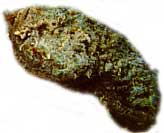
The stonefish lives in the ocean in northern parts of Australia and is usually a mottled greenish-brown in colour with its skin having many stone-like appendages which gives it a near perfect camouflage against the background it prefers. The most amazing feature of this fish is its spine of 13 grooved hypodermic-like projections, each capable of piercing a sandshoe. Stonefish can live out of water for many hours and grow to about 30 cm in length. Its main habitat is on coral reefs, near or about rocks, or often it just lies dormant in the sand or mud. Though not deadly it can give an extremely painful sting. There is also a fresh water variety called a bull rout.
Stout infantfish
The first one of this tiny species was discovered at Lizard
island in north Queensland in 1979.
A fully grown adult stout infantfish grows to a maximum of seven mm. and
weighs only one milligram! They also do not live longer than two months
and never get to develop fins, teeth or scales and reach maturity in only
one month but as they are paedomorphic they retain larval characteristics
all their life. The female lays her eggs when she is only two to four
weeks old and then dies not too much later. The fish has been submitted
to the Guiness Book of Records to be listed as the world's smallest vertebrate.
Tasmanian Devil
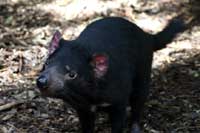
Tasmanian Devil
Photo by Katrin Holmsten
The Tasmanian Devil is a small but fearsome creature. Info on this one to be added soon, or if you're a wildlife expert write the Tasmanian Devil page for us!
Tasmanian Tiger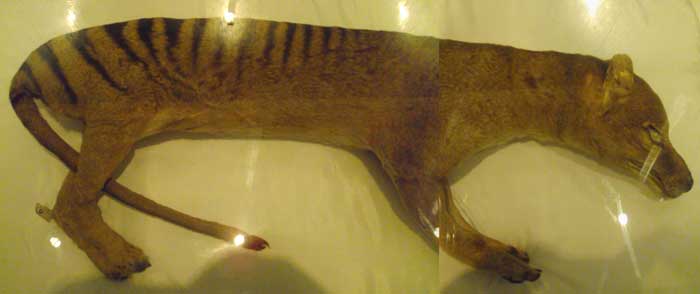
The preserved body of a Tasmanian Tiger in the National Museum in Canberra
Officially known by zoologists as a thylacine, this large,
carnivorous marsupial predator used to live all over Australia 10 000
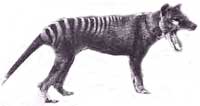
years ago but the last one of this species died in the Hobart Zoo in 1936
( hence the black and white photograph). Since then people still have
reported regular sightings totalling over 4000 though nobody ever managed
to come up with a decent quality photograph. A lot of the sightings are
usually by owners of Tasmanian wildlife parks (who then get the name of
their park in the newspaper for free) but even on mainland Australia people
have reported sightings, ranging from Victoria to Western Australia to
the jungles of North Queensland. Considering the vast amounts of Tasmanian
jungle that is still nowadays inaccessible to humans the possibility of
a Tasmanian tiger existing there is not all that far fetched.
It was the tiger's appetite for sheep brought in by the European settlers
that made him so unpopular, to the point where it was hunted to extinction.
To see a Tasmanian tiger in color buy some Cascade beer, besides being
a good drop it also has the tiger on the label.
In February 2005 a Melbourne man walked into the Tasmanian Museum and
Art Gallery and showed staff photos on his digital camera that his German
brother had shot, of an animal that appeared to be a Tasmanian tiger,
and said the pictures were taken recently in the Lake St Clair region.
Unfortunately he then left again and did not leave any copies. Senior
staff confirmed that the photos did appear to be of a Tasmanian tiger
but had not had the opportunity to examine the photos close enough to
establish their authenticity.
Professor Mike Archer, dean of science at the University of New South
Wales, started a project in 1999 to clone a Tasmanian tiger from DNA samples.
This proved unsuccessful due to poor DNA samples and a lack of facilities
and skills and the project was dumped by the Australian Museum in February
2000. But in October 2005 it was announced that American researchers with
genetic sequencing capabilities will be involved for the first time and
their expertise is expected to open up new possibilities for bringing
the thylacine to life.
American yachtsman Ted Turner offered a $100,000 reward in 1983 for anyone
finding a live Tasmanian tiger and entrepreneur and adventurer Peter Wright
spent $250,000 on his unsuccessful hunt for the tiger in 1985.
In 2005 Kerry Packer's Bulletin Magazine offered an even bigger reward
of $1.25 million to anyone offering conclusive proof of a live, uninjured
Tasmanian tiger in the wild, but this reward never got claimed.
Termites
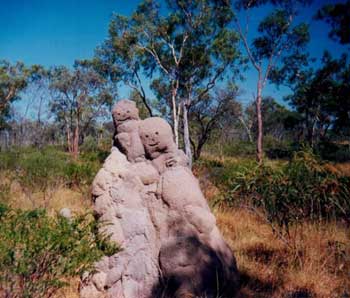
Photo by Rob Lapaer of Rainforest
Hideaway B&B, Cape Tribulation, N.Qld.
A termite mound with a difference
Termites are the big worry of every house owner in Australia, if left unchecked they can devour a house in les than a year. They are also referred to as white ants but though they may look white they are not related to ants. Travelling through the outback you will see endless numbers of termite mounds, varying from small to five metres high or even flat like the ones in Llitchfield Park, N.T. resembling a grave yard full of tomb stones. The mound on the photo above has had a bit of help from people by the looks of it, it is not uncommon to see termite mounds that have old tyres or other objects embedded in them too as the termites will just work around any objects placed on or around the mound.
Tree kangaroo
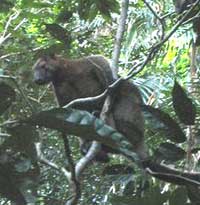
Photo by Sheena Walsaw
Yes, believe it or not, in north Queensland three are kangaroos that live in trees! They look a bit different from your average kangaroo though. This one was spotted at Cape Tribulation Jungle Surfing.
Wombat
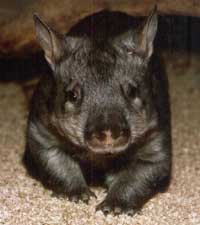
Thanks to Camille Espzel for this wombat picture
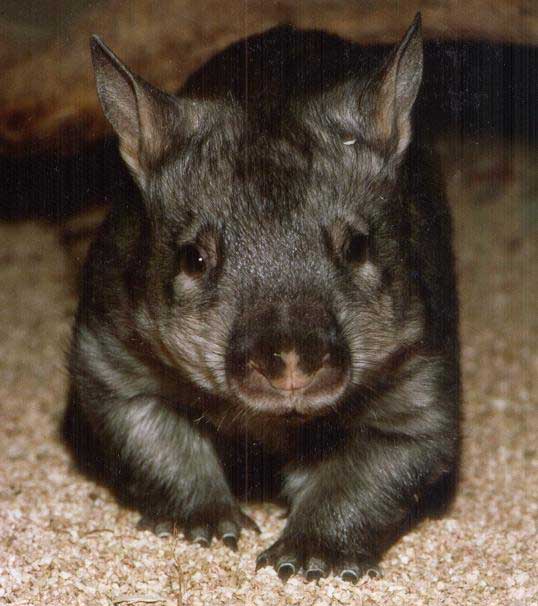
Marsupial animal resembling a bear or furry pig that digs hollows to live in, mainly lives in southern Australia from east to west. Also known in Australian joke as the animal to most closely resemble the Australian man; because he eats, roots(,) and leaves. More info on wombats...
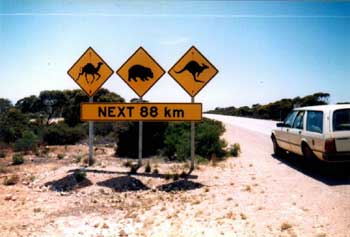
Photo by Rob Lapaer of Rainforest
Hideaway B&B, Cape Tribulation, N.Qld.
Warning sign for wombats on the Nullarbor plains

HOME PAGE
Tourist Information
General Information
And Entertainment
ACCOMMODATION IN AUSTRALIA
Bed
& Breakfast
Budget
Accommodation
Backpackers Hostels
Hotels
in Australia
CAR HIRE IN AUSTRALIA
Australia Rental Cars
And
Campervans


TOURS
IN AUSTRALIA
What To Do In Australia
On-line
Shopping
On-line
Dating

About
Australia
Visas For Australia
How
To Get To Australia
How To Get Around
Travel Insurance
Travel Guides
Working
In Australia
Australian
Posters
Survival
Tips
Weather,
When To Go


Use of
this website constitutes acceptance of the User Agreement for this website
Contact us |
Advertise on this site
| Link to this site |Add
your photos or stories to this site |
Webmasters | Affiliates