 Accommodation | International
Flights | Domestic
Flights | Tours
| Travel
Insurance | Car
Hire | Visas
| Shopping
| Dating
| Humour
Accommodation | International
Flights | Domestic
Flights | Tours
| Travel
Insurance | Car
Hire | Visas
| Shopping
| Dating
| Humour
Amazing Australian Laws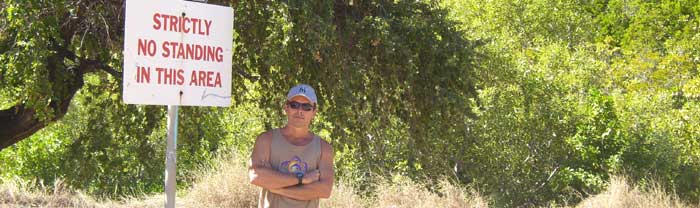
Besides all the usual laws banning hard drugs, murder, theft etc, Australia also has some pretty unique laws found nowhere else in the world.
Below is a selection of them;
Aboriginal payback
The Australian court system recognizes in certain cases
the ancient Aboriginal tribal laws where offenders are punished for their
actions by members of the victim's family.
For instance in the case of a murder in 2002 in Central Australia, Alice
Springs magistrate Michael Ward ordered the murderer be taken to Nyrripi,
about 450km west of Alice Springs, where he would suffer traditional Aboriginal
justice, or payback, at the hands of the victim's relatives who speared
Webb no less than 13 times and also broke his ankle during a ceremony
that was witnessed by police and health workers!
In 2011 some muslims suggested to also introduce some mild form of Sharia
law in Australia but politicians were quick to knock this one on the head....
Anti-hooning laws
Hoon is the Aussie word to describe someone with anti social driving behaviour, typically under 25 years old driving too fast, making too much noise and doing dangerous and unlawful stunts. To combat this problem anti-hooning laws have been introduced giving police extra powers to confiscate cars of hoons, as this is what hurts them most, more than a simple fine to pay.
Beer can crushing
In Western Australia it is illegal to crush beercans between
your breasts in the pub!
A 31 year old barmaid who worked at the Premier Hotel in Pinjarra, south
of Perth, ended up in court and was fined $1000.- for crushing beercans
between her breasts!
Bicycle helmets
In Australia it is illegal to ride a bicycle without
a helmet! In the late 1980s a Canberra politician was doing a
few calculations and worked out that a certain percentage of people in
hospitals were there for bicycle accidents so if they were made to wear
helmets there would be a few percent less injuries so the country could
save a few dollars.
It quickly became law throughout Australia but the Northern Territory
resisted for some time to implement this ridiculous law. However the Canberra
lawmakers were that hell bent on Territorians to wear the plastic helmets
in their stinking hot weather that they threatened to withhold millions
in road funding so eventually the N.T. gave in.
Many Territorians protested and argued that it should be up to individuals
to protect themselves, if the government wanted to save money on medical
care they should also have sunscreen police on the beaches, posture police
to check your chairs etc.
It would be like requiring every office in the territory to provide ergonomic
Ergohuman furniture.
In late 2011 the site helmetfreedom.org
was launched, and in a TV show the organizer made his case for the helmet
laws to be repealed, as statistics show that it does not significantly
make cycling safer, and that it stops a lot of people form cycling because
they do not want to wear the helmets, and that it causes cycle share schemes
in Brisbane and Sydney to fail, which has a negative impact on environment
with more people using motorized transport, and a negative impact on pulic
health, as less people get their exercise through cycling. Read more about
the stupidity of bicycle helmets here.
Bullet proof vests
In Australia it is illegal to own a bullet proof
vest unless you have special police approval.
The need for restrictions on guns are obvious but bulletproof vests could
not harm anybody else and can only protect people, seems strange to outlaw
them...
Even the most experienced gun
crime lawyer Columbus, who handles cases with weapons charges every
day, would have a hard time understanding such a law.
Cats and dogs eating ban
In october 2003 the Victorian parliament introduced legislation
banning the eating of cats and dogs.
Authorities apparently receive regular complaints of people eating cats
and dogs but a recent report that somone had bought a puppy for the purpose
of eating it led to this new law which also prohibits people from slaughtering
any other animal not included in the Meat Industry Act as "consumable".
Cheese license
Queensland Fancy Cheese Products - a succesful 37 year old family business that has become an institution in the Brisbane suburb of New Farm was instructed to close down by the court in january 2004. Not because there were any health or safety concerns, and the judge even admitted that they were manufacturing a high-quality product, but simply because they were not accredited cheese makers! Never mind they had built a reputation over 37 years with high quality cheese!
Compulsory voting
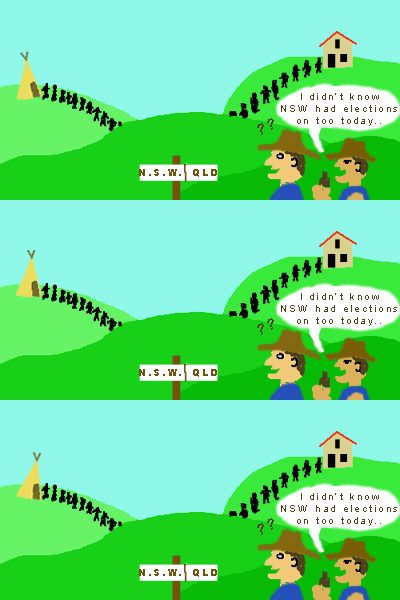
In Australia it is compulsory to vote,
even if you can not find any political candidate that you could possibly
have any confidence in you still have to go to the polling station and
cast your vote. As by this stage your name has been recorded as having
shown up it now does not matter anymore what you actually write on the
ballot paper as it can not be traced back to you so identities like Donald
Duck tend to get quite a few votes even though they are not actually running
in the elections.
After the february 7 elections in Queensland electoral commissioner Bob
Longland said that many letters had been sent out informing people they
had to pay a fine unless they had a good excuse. The ECQ collects more
than $1 million from non-voters at each election. Many excuses were made
and you could have walked across Moreton Bay for all the broken-down fishing
boats but the best one of all was a woman whose excuse was that she was
having group sex with 30 men in hippie-haven Nimbin, NSW, and could not
get to a polling booth in Queensland on time to vote.
Crocodile kill
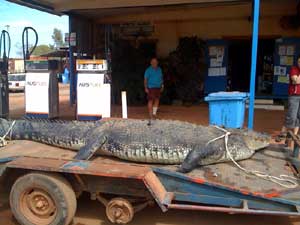
This croc was shot when it threatened fishermen
The punishment for illegally killing one of the Top End's 70,000 crocodiles is a fine of up to $55,000 for an individual and $275,000 for a company - or up to five years' jail.
Daintree building moratorium
Most people think that in a democratic country like Australia
in the 21st century citizen's rights are protected and your local government
is there to ensure prosperity for its constituents.
Not so in the Daintree area, after the 2004 Douglas Shire Council elections
all hell broke loose when Mike Berwick
set off the timebomb he had been secretly preparing that imposed an immediate
ban on all new building and development approvals, until his radical townplan
would come in to force that stopped people from building on their freehold
land in many areas, and placed severe restrictions on others.
This made the Daintree area north of the river the Bermuda Triangle of
property investment, property prices have plummeted and sales have stagnated,
many people that had bought land to build their dreamhome suddenly found
themselves with a worthless piece of land that could not be built on.
An information day was organized at the local school to tell devastated
residents exactly how screwed they were, and no less than three police
officers were at Mike Berwick's side to protect him from natural justice.
People that had owned land for years or decades were suddenly told that
they could either sell their land to council for peanuts, or invest in
lawyers to attempt compensation through the courts.
Numerous divorces and even some suicides have been blamed on this townplan
that ruined many people's lives.
Daintree grid power ban
 Pollution
of exhaust fumes, oil and old lead-acid batteries in the rainforest.
Pollution
of exhaust fumes, oil and old lead-acid batteries in the rainforest.
Out of all the stupid laws in Australia this one would have
to be the in the top three.
The Queensland government has laws that ban electricity grids being established
north of the Daintree river!
In a time where governments around the world move to more sustainable
and greener practices the Queensland government prefers it if the Daintree
population runs a polluting generator for each house and each business!
When solar power subsidies were still available many households had solar
panels and batteries installed, but in a rainforest with an average 265
days a year of clouds and a rainfall of up to eight metres a year solar
power is like hydro power in the desert, it'll work for about one week
a year and what do you do the rest of the time?
Most residents want some type of grid power and frequently contact politicans
but they either get no answer or a short note that "options are being
investigated". Meanwhile three million litres of diesel is trucked
up every year to be burned up by hundreds of polluting generators. Read
more about this nonsense of pollution
in the Daintree.
Warren Entsch
is one of the few politicians with some commonsense on this issue, he
has stated that his party have a policy in place to recind the ban on
grid power within 100 days of being elected and install an environmentally
friendly grid power system, thereby restoring and fulfilling human and
civil political rights to residents affected by current state government
policy banning grid power north of the Daintree River.
It would be a great outcome for both environment and the Daintree residents
if his party wins the next elections!
Drughouse law
In the Northern Territory your home
can be declared a "drughouse" by police when they suspect
that "more probable than not there are drugs being used or
sold in your house". |
|
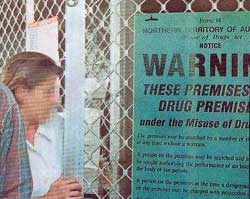
Your house may be searched by a member of the police force at any time without a warrant, anyone on the premises may be searched, every person who is found on the premises at the time a dangerous drug is found on the premises can be charged with possession of the drug, and anyone who is on the premises or within 200 metres of the premises can be required to provide a member of the police force with their name and address. Those arrested for possession may even be ordered by the court to undergo mandatory drug addiction recovery treatment.
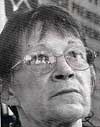
The first drughouse to be adorned with this poster
in Darwin was that of
grandmother Margot Laughton who was arrested on Thursday, 26 February
2004 by plain clothes Drug Squad police officers at her home in
Coconut Grove in Darwin. They charged her with 3 offences and she
was locked up in Berrimah Prison. A Northern Territory News journalist
that had befriended her before the shit hit the fan labelled her
'The Gunja Granny' in the local newspaper. |
|
Euthanasia
In Australia you can end up in court for keeping an animal
that is suffering pain and is beyond medical recovery but you can also
go to jail for helping to end the life of a human being that is suffering
the same pain. The Northern Territory introduced their famous euthanasia
legislation in the 1990s to allow terminally ill people to end their suffering
but the Federal Government in Canberra used their powers to overturn any
decision made by the Northern Territory (as it is not a state and only
has limited self-government ) and the laws were swiftly repealed.
One person involved in this situation was Philip Nietschke, an Australian
doctor who became famous for his views that people who are beyond saving
by medical science and who are suffering pain should be allowed to die,
he pushed his views thorugh to the point where he assisted some people
to end their lives and even invented a machine that produced carbon- monoxide
that people could use to end ther lives but customs officers confiscated
this machine when he was on his way to a conference in the U.S. He also
wrote a book titled ' The Peaceful Pill Handbook ' but had his first print
run confiscated at customs arriving back from the U.S. , later the Office
of Film and Literature Classification cleared the book and he was allowed
to print and distribute the book in Australia.
Fuel truck must travel alone
Ferry across the Daintree river
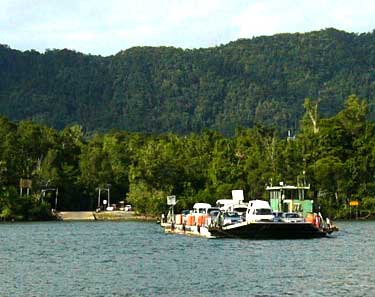
On the Daintree river ferry in north Queensland the local
council regulations say that trucks carrying fuel have to travel on the
ferry alone, with no other vehicles or passengers, even if it is peak
time and queues are built up on both sides of the river.
This while the fuel truck sits in the normal queue before it reaches the
ferry with people walking around the truck smoking cigarettes, but then
on the ferry where smoking is not allowed the fuel truck has to travel
alone!
What sounds safer to you? Walking around a fuel truck on the road with
a cigarette in your hand, or sitting next to a fuel truck on the ferry
in your car while you are not smoking?
Goldfish laws
In Queensland you will be hit with a $150,000.- fine if you are caught releasing a goldfish, or even a tiny guppy, in a waterway. Releasing a carp or even possessing a carp, even a dead carp,or part of a carp, will cost you the same.
Mandatory detention
Since 1976 people have been arriving in Australia on (often very unsafe) boats seeking asylum, and although Australia is usually a generous nation willing to lend a hand to those in trouble, the government did become concerned that this would open the floodgates and massive waves of people could flood the country, so they started to discourage people by making it mandatory that anyone arriving by boat without a visa must be kept in detention until his or her refugee application has been processed. In line with the National Anthem that sings "for those who've come across the seas, we've boundless plains to share" these detention centres are usually in remote places like Woomera in South Australia or Port Hedland in Western Australia. When protesters started to find their way even to those remote locations the "Pacific Solution" was introduced, where governments of Pacific islands were paid to have detention centres on their islands. A tally is also kept of the cost of detention and processing of these refugees and a bill presented to them on deportation, although it remains to be seen how many would actually pay this, one family that exhausted every legal avenue for three years managed to clock up a bill of no less than three million dollars!
Melbourne hook turn
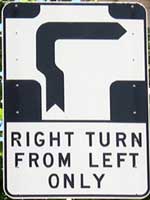
If you're turning right at an intersection you would normally go to the centre of the road and, when there is no traffic coming from the opposite direction, make your turn. Not in Melbourne! At a small number of very busy intersections in the centre of Melbourne's CBD, where two tram lines cross each other, you have to pull over to your left, wait until the traffic light from the street you want to turn into changes to green, and then complete your turn!. If cars were waiting to turn right from the middle of the road, they would be blocking the tram lines, thus holding up a large amount of trams. To ensure the flow of traffic stays at a reasonable level, the hook turn was invented.
Nappies for horses
Horses could soon be wearing nappies on city streets to stop them dropping waste, if voted in by Melbourne City Council on Thursday 4 december 2003, the new rules will also ban horse-drawn carriage rides in the CBD when the temperature exceeds 34C.
No alcohol zones
To combat alcohol problems in Aboriginal communities some
areas of Australia, in liaison with Aboriginal elders and Land Councils,
have been declared "dry areas". This means no alcohol what so
ever is allowed to be consumed or brought in, even if you are an overseas
tourist. Stiff penalties apply to those who break the laws. Sly groggers,
a name for unscrupulous people who try to make their fortune selling alcohol
in dry areas at extortionate prices, often get fined, jailed and their
vehicles confiscated. Still, some residents of dry areas have been known
to drive 800kms to the nearest bottle shop or charter planes to pick up
their grog.
You could also find that the only bottleshop in town ( and the next town
500 kms down the road) is closed because it is social security pay day,
and authorities try to get the local population to spend some money on
food for the kids before spending it at the pub. Argueing with the bottle
shop staff that you are a tourist will not get you anywhere, rules are
rules.
Early 2004 the 'Winegate' affair hit the news head lines,
a minister for Aboriginal affairs had flown into a strictly dry area on
Cape York with a bottle of wine aboard the plane. Indigenous Affairs Minister
Liddy Clark made a trip on a government jet to the alcohol-restricted
Aboriginal community at Lockhart River in Cape York in February 2004 but
while the plane was on the tarmac there, a bottle of red wine was discovered
on board by Lockhart River airport manager John Hardaker. Government media
adviser to Liddy Clark Teresa Mullan had brought it along and was sacked
but later reinstated by Premier Peter Beattie. After lengthy investigations
by The Crime and Misconduct Commission and countless taxpayers dollars
wasted nobody was charged as the tarmac of the airport was considered
not a public place under liquor legislation. Tourists have also been fined
thousands of dollars for having alcohol with them on their holidays, if
you head this way check on alcoholimits.qld.gov.au
or ring 1300 789 000 for up to date info on restricted areas.
And don't think it is all a joke, penaly for a first offence is a maximum
of $37500.- , second offence $52500.- or six months in prison, and third
offence $75000.- or 18 months in the slammer, on top of that they may
also confiscate your vehicle.
No bathing
Bondi Beach in Sydney
It used to be illegal to swim here during daylight hours!
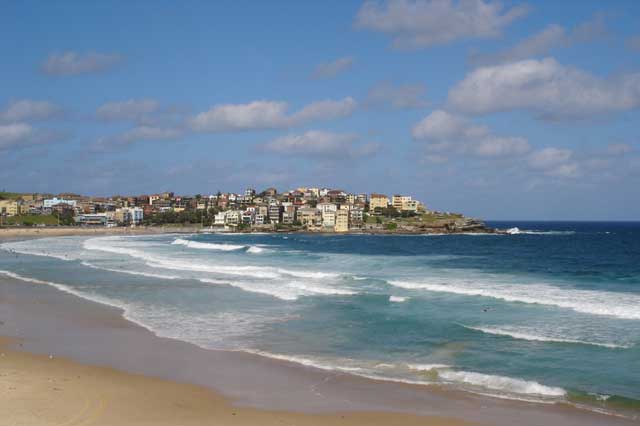
At the start of the twentieth century a group of enthusiastic body surfers in Sydney managed to convince the government to overturn a law that made it illegal to bathe in the ocean during daylight as it was considered too indecent!
No drinking
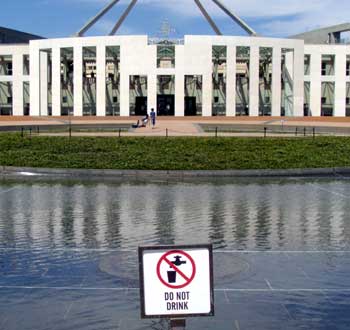
Make sure you're not thirsty when you go to Parliament House in Canberra, it is not allowed to drink from the pond !
No ferrets
If you have a ferret as a pet in Queensland make sure you have a permit as under the new Land Protection Act you will cop a whopping $60,000.- fine if caught by the authorities.
No food to be brought in to Australia
When your plane lands make sure you have no food in your
bags, do not even take anything left over from the plane food with you.
Any food, seeds, plants, wood, soil on your shoes, sneakers, etc. could
potentially carry a disease or insect that could become a plague in Australia
so either dump it or declare it as the fines can be high and harsh if
they find anything on you.
Some people that bring traditional foods with them when they visit family
in Australia get very upset when it is taken off them but rules are rules
and they are strictly enforced.
Dylan Graves, a Swiss student studying English in Western Australia, was
fined $4,000 in a Perth court after having been caught hiding a 400 gram
salami at Perth International Airport in November in November 2004.
No freshly cooked food at the markets
The Sunday markets in the north Queensland resort town of
Port Douglas are a very popular venue, and one of the attractions was
the food. Until one day the local Douglas Shire Council decided, in its
infinite wisdom, to prohibit the cooking of food at the markets, and only
pre-cooked food was allowed to be sold.
Now what are you more likely to get sick from, freshly cooked food or
food that was cooked yesterday?
No gangsters at horse races or in casinos
In Victoria police can issue people they suspect of having links to organized crime with an exclusion order which prohibits them from entering casinos, horse racing tracks and betting rings. Breaching of this order will cost you $2000. In NSW the penalty is a bit tougher at $5000.- or twelve months jail.
No joking
In June 2005 it was in the national news that Aussie airports were now declared "no-joking zones", several people had been fined heavily for joking about bombs or other terrorism related things, and the public was warned not to make any more jokes in airports and on planes.
This came too late for Cairns student Patrick Carroll, who was in Darwin airport when he got a bit thirsty, so he left his luggage on a trolley to go and buy a beer. When he returned from the bar a security man was inspecting his luggage and Patrick called out to him; "Don't worry, I left the bomb in Iraq, mate!" He ended up in court, managed to be released on bail and had to come back in December 2005 to hear the end of it.
Another Cairns man (what is it with these jokers from Cairns?)
had landed at Cairns airport but became frustrated with the time the disembarking
took so he thought people would move a bit faster if he told them that
there was a bomb on the plane.
It is not clear if it made the passengers move quicker but it certainly
made the police move, they arrested him and although his lawyer tried
to convince the judge that it was all meant as a joke, the judge did not
see the funny side of it and fined him $4000
No lying
In 2012 the Queensland LNP Government re-instated the law that makes it illegal for a politician to lie, the law had been abolished by the Labor Government in 2006.
No marriage for brothers and sisters
Under the Federal Marriage Act 1961, it is illegal for brothers and sisters to marry but West Australian couple Kevin and Deborah Jefferies who are brother and sister by adoption, but unrelated by blood, are battling the federal law that prevents their marrying.
No marriage for public servants
Up until 1966 the Commonwealth Public Service had a ban on married women. Women that performed their jobs perfectly well were forced to leave their jobs if they married!
No mates in Canberra

On 20 August 2005 it was decided by the Australian government
that the security guards in Parliament House in Canberra
were to be banned from addressing politicians and members of the public
with the term "mate'.
This ban lasted only 24 hours, after which it was decided it was ridiculous
and unworkable and the ban was lifted.
John Howard said he had no problems with use of the word mate in Parliament
and Kim Beazley said he insisted on being called mate.
Not much later it was decided in the Northern Territory Parliament that
politicians were not allowed to call eachother 'buggerlugs', but the term
'dickhead' was still allowed.
No more beer wenches
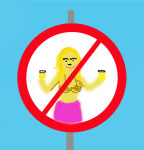
November 2003: the NSW Gaming and Racing Commission Minister
has raised concerns about women buying drinks at the bar for patrons at
sporting events and the State Government is considering to outlaw this.
Does the government not have something more important to do with their
time?
January 2004: four beer wenches have been ejected from the Sydney Cricket
Ground for selling alcohol during the fourth Test between Australia and
India.
No musical instruments on the bus
In the Northern Territory the Transport Act says that it is illegal to play a musical instrument on a bus!
No nudity in Queensland
Under the Vagrants, Gaming and Other Offences Act of 1931,
public nudity is an offence in Queensland and a person charged with wilful
exposure faces a penalty of $100 or six months imprisonment. But while
governments around the world are relaxing laws in this area and other
states in Australia have had clothing-optional beaches for up to 30 years,
the Queensland government has plans to pass the Summary Offences Bill,
which will increase penalties for wilful exposure to $150, or if the offence
involved circumstances of aggravation, a maximum penalty of $3000 or one
year's imprisonment! Nudist activists say that Queensland is missing out
on millions of nude international tourism dollars every year.
South Australia already opened Australia's first official nude beach in
1975 and Don Dunstan, South Australia's premier at the time, said that
"unless people were hurting others in the community, they should
be able to be individuals and do their own thing". Since then nude
sunbathing has become legal in all of Australia except for Queensland.
No porn movies
Laws in all Australian states prevent the legal sale of X-rated films, but it is allowed in Canberra and the Northern Territory. That's why Brisbane porn star Jodie Moore sells her movies online.
No porn sites
When the internet was just becoming popular and the first
pornsites starting to happen the Australian government, despite having
relaxed laws allowing the porn industry to thrive in Canberra, decided
they were going to keep this evil out of Australia and prohibited pornsites
from operating in Australia.
This was a futile attempt as now the pornsites that were already operating
moved to the U.S. so Australia missed out on the income of these thriving
businesses and Australians can still view these sites just as good as
the internet is international and it does not matter where they are based.
Around 2002 they finally relaxed the rules on .com.au domain name registration
causing a frantic rush to register names that had been taken up ages ago
as a .com .
Within minutes of the new rules taking effect names like f%*#.com.au ,
sex.com.au etc. were registered, soon to be followed by sex.com.au , tits.com.au
and the whole range that Australia could have had contributing to its
economy for years before that.
No purple houses in Wagga Wagga
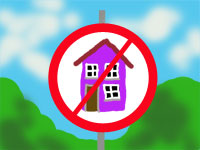
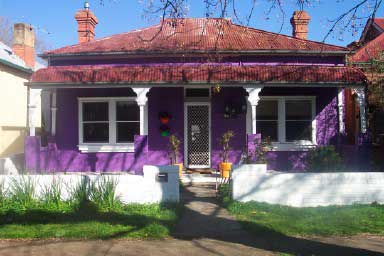
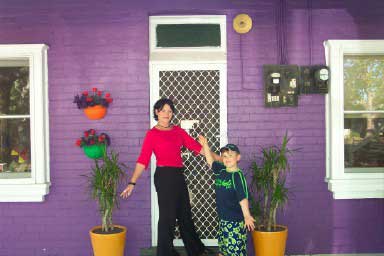
In 2003 a couple in Wagga Wagga, N.S.W. decided to paint
their house at 56 Best Street purple. The local council pointed out to
them that it is illegal to paint your house purple in
Wagga Wagga and has set aside $25000.- to take legal action through the
Land and Environment Court. Does the Wagga Wagga council not know that
in Normanton there is a purple pub that is one of the main tourist attractions
of the town?
Luckily in 2004 the council and mayor were replaced by some new ones who
so far have not dared to involve themselves in this situation. Local musos
have made support songs that were played on local radio, and hundreds
of people have signed petitions and letters of support so it looks like
this purple house will be there for a few years to come.
|
|
No recycling
Believe it or not, but when residents put out their rubbish
on the footpath because they want to get rid of it, it is illegal in many
towns to take anything of it for your own use!
In a time where recycling is promoted everywhere as a good way to help
the planet's problems you can not pick up something that is useful to
you from the footpath, even though this is destined to go in to landfill.
Many Aussies don't even know about this but when news hit the headlines
that former motorbike champion Trevor Flood was charged with taking a
vacuum cleaner from a footpath rubbish pile people learned about this
and many queried the logic of such a law...
No singing in Willoughby park
Heading down to the park in the Sydney suburb of Willoughby? 90 year old Alan Waddell, who has walked more than 2000 kms through every street of 143 Sydney suburbs, found these beauties, we borrowed these pictures from his website Walksydneystreets.net |
 |

No swearing
Queensland Premier Anna Bligh has announced new powers for
the state's police to issue on-the-spot fines of between $100 and $300
for swearing and abusive language.
In the year before there had been court cases in which a Sydney student
was let off for using the word 'prick' to a police officer and a Queenslander
who went to court for telling police to F*#! off was also let off and
the police union told to pay his legal costs.
Victoria followed suit and from 1 July 2011 police can fine people $240.-
for using language deemed to be indecent, disorderly, offensive or threatening.
Poor Melburnians, can't even complain about their F%#!ing weather anymore!
No vacuum cleaners
Since December 14 it has been against the law in the outer Melbourne suburb of Brimbank to vacuum clean your house between 10pm and 7am on weekdays and 10pm and 9am on weekends, noisy cleaners will cop a $205 on-the-spot fine, which can rise to a $1000 court fine if it is not paid, and subsequent violations attract fines of up to $2000!
No water skiing at night
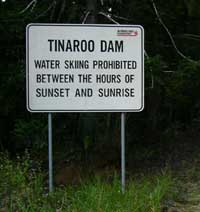
If you like nocturnal water skiing forget about a holiday to the Atherton Tablelands, (west of Cairns in north Queensland), here it is against the law to waterski during the night!
Nothing to be removed from National Parks
If you visit one of Australia's many National Parks, bear in mind you are not allowed to remove anything. this does not only mean you are not allowed to dig up trees but you can not even pick up a seed, pebble or stick to take home as a souvenir.
Pacific Island Labourer Act
This act was passed by government in 1901 to put an end to Australia's version of the slave trade that is so well known of America in its early days.When white settlers first started turning the landscape into sugar cane plantations they found it hard going in the tropical heat and honestly believed that white people could not work in such circumstances. While the Dutch were succesful getting Indonesians to work hard on spice plantations Australian settlers were not so succesful getting Aborigines to do the same (though they proved their skills as horsemen and workers on cattle stations). A solution was found in sailing out to Pacific islands and kidnapping people to bring back to the cane fields, starting around 1860 at least 800 ships had "kidnapped" at least 60,000 islanders and sold to Queensland sugar growers. Though officially they were not slaves the pay was that ridiculous that they could not afford to return home and thus had little choice other than to stay and work to survive. The government passed the Pacific Island Labourerer Act in 1901 to abolish this practice and by 1906 ordered their repatriation, though not all of them returned and even nowadays you can see dark skinned people in sugar cane areas that are not Aborigines but descendants of Pacific Islanders that decided to stay.
Pig Penalty
In Queensland you can be fined $30 000.- for keeping a feral pig as a pet.
Six O'Clock Swill
Up to February 1, 1955, the law stated that bars in Australia had to be closed at six pm! Much to the delight of drinkers this law was narrowly overturned in the Referendum of 1954 so pubs could now keep their doors open till 10.00 p.m.. Before then amused tourists used to watch Aussies knocking back beer like there was no tomorrow in a guzzling frenzy with drinkers being too scared to move from the bar for fear of losing their place and not being able to get their daily quota down before the bar closed! This frenzy was known as 'the six o'clock swill' .
Skippy-free diet
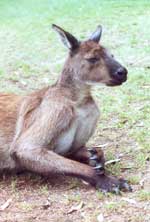
Up to the early 1990s it was in many Australian states against the law to eat kangaroos, now roo burgers and steaks are found in many places where tourists go.
Sperm donors
It is illegal in Australia to`pay sperm donors and it is also illegal to import frozen sperm and there is a limit here of 10 families who can use sperm from one donor. Also the NSW Government is expected to pass a law allowing people to learn who their biological parents were to end so-called "genetic bewilderment. This led to such a shortage of donors that the Reproductive Medicine Centre in Albury advertised in Canada in the sports section of Alberta's Calgary University student newspaper offering sperm donors a $7000 package of free return trip, accommodation for a fortnight and a daily spending allowance. An avalanche of emails followed from Canada, Russia and other countries.
Superannuation
When you work in Australia you will find you have to pay
something called super, or superanuation.
This is the Australian terminology for pension fund. It is not a voluntary
saving, you must pay.
Click to find out what is superannuation?
Tasmanian homo sexuality laws
In Tasmania it was, up to 1997, illegal for two men to have
sex together, even if they are consenting adults and are in the privacy
of their own home where nobody can see them or be aware of it. The offence
carried a 21-year jail term. At least Sydney can be assured it will be
a long time until a Hobart Gay Mardi Gras will overshadow their annual
festival.
The politician that was the driving force in removing this law was Bob
Brown, a Tasmanian himself, and gay as well, so at least he won't have
to go to jail if he would ever get caught in bed with his partner.
He had already spent time in jail, not for corruption as you would expect
from a politician, but for protecting the environment. As the director
of the Australian Wilderness Society he was one of the leading forces
to block the damming of the Franklin River in Tasmania in 1982 and 1983.
1500 people were arrested and 600 jailed, Bob was one of them and spent
16 days in Risdon Prison, and he was elected to Tasmanian Parliament on
the day of his release!
Tasmanian prostitution laws
The Tasmanian government decided early 2004 to legalize brothels, before that Tasmanian law had never actually outlawed prostitution, but it had been illegal for brothel operators or pimps to live off the earnings of prostitution. So if you left it all in a saving as account or donated it to a political party you were within the law.
Traditional hunting
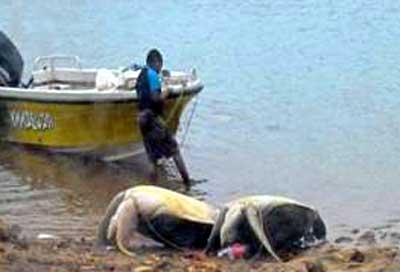
Traditional hunting of sea turtles with traditional outboard motor and
traditional alumimium boat
Australia has laws that protect its native wildlife, and
especially the endangered species.
But there are exceptions for Aborigines, and the law says that Aborigines
can hunt and kill such animals as sea turtles and the endangered dugong.
The philosophy behind this is that the eating of these animals has been
part of their culture for thousands of years.
Many debates have raged over the traditional hunting issue, some people
say let them do what they have done for thousands of years, some say put
a stop to it if these animals are endangered, and others in between those
say OK but hunt these animals in the traditional way then, NOT with motorboats,
guns, spearguns and other modern technology.
White Australia policy
The White Australia Policy, the policy of excluding all
non-European people from the Australian continent, was the official policy
of all governments in Australia from the 1890s to the 1950s, and the final
elements of it were only abolished by the Fraser government's review of
immigration law in 1978.
Although the expression “White Australia Policy” was never
in official use, it was common in political and public debate throughout
the period.
The origin of the policy can be traced back to the 1850s when large numbers
of Chinese came to Australia during the gold rushes. The Anglo-Australian
population resented the Chinese undercutting "white" labour
and by 1888 new Chinese arrivals were banned from all the Australian colonies.
a "dictation test" was introduced as a device for excluding
unwanted immigrants.
Immigration officials were given the power to exclude any person who failed
to pass a 50-word dictation test in any European language.
Women's wages
At the start of the 20th century women were not paid very
well but this changed in 1919 when women were awarded 54% of the national
basic minimum wage for men, (assuming working women are single and do
not need to pay for a wole family like men do).
In 1950 women got an even better deal when their minimum wage went op
to 75% of men's wages. And in 1972 it got even more better when female
public servants were awarded the same pay as men!
Some more legal information
What does "duty of care"; mean in personal injury law?
How is the definition made in different fields?
What does "duty of care"; mean in general terms?
A duty of care is a legal obligation that we have to uphold to avoid misbehaviour that might reasonably result in injury to another person. Everyone has a duty of care, which is a responsibility to guarantee their own safety and the safety of others. The health and safety of all your workers and guests at the workplace is largely your responsibility if you own a business. Informing patients of the treatment's potential side effects and taking adequate precautions are your duties as a surgeon. The reasonable decision to be made in this and similar cases can create a general definition for duty of care. You need to think carefully about the consequences of the action you take or the decision you make.
What is a breach of duty of care? What to do in such a situation?
A simple definition of a breach of duty of care is when you negligently inflict injury on another person. To put it more simply, a duty of care has been broken when someone suffers harm as a result of another person's behaviour or inaction where it was reasonably foreseeable that the action would cause injury and a reasonable person in the same position would not have done that way. Duty of care can be violated in many different areas. Among them; public liability, medical negligence, workers compensation and motor vehicle accident compensation.
Duty of care and public liability
You may be entitled to compensation if you sustained a physically or psychological injury on public or private property as a result of the occupier's carelessness. Everyone has a liability to ensure the safety of others, including individuals, businesses, and organisations. This comprises public, commercial, and retail properties as well as venues, shopping malls, supermarkets, sports grounds, parks, gardens, and pathways.
What is covered under public liability compensation claim?
loss of earnings from the past and future
medical expenses
domestic assistance
lump-sum pay-out for pain & suffering
What sorts of incidents typically give rise to claims for public liability?
wet surfaces can cause slips and falls.
injuries brought on by shattered glass
heated food and drink-related burns
injuries caused by things falling
attacks-related injuries
canine bites
on walkways, people trip and fall
assaults
It should also be noted that; supermarkets, shopping centres, rental properties, parking lots, schoolyards, and sports fields are common locations where accidents resulting from carelessness happen.
Duty of care and medical negligence
You may be eligible for medical negligence compensation claims if a healthcare professional (such as a surgeon, doctor, pharmacist, etc.) breaches their duty of care and causes your injuries.
What does medical negligence compensation cover?
You may be eligible to compensation for the following if a healthcare
provider's carelessness causes your injury:
medical expenses
travel expenses
loss of income
domestic assistance
permanent impairment
pain and suffering
Duty of care and workers' compensation claims
If your employer caused your injury while you were at work, you can also
be eligible for a settlement for work injury damages in addition to workers
compensation.
When a claim for workers' compensation was made, the following rights
were generally included in the compensation:
weekly compensation for your disability
expenses for treatment and recovery
travelling expenses
payments to retrain you for employment or to assist you in returning
to work
a lump sum payment for permanent impairment
The amount of compensation you may be eligible to receive depends on several
criteria.
Duty of care and motor vehicle accident compensation claim
You may be eligible to make a motor vehicle accident claim for compensation
benefits and a lump sum payment to account for your future if you were
injured in a motor vehicle accident that was someone else's liability.
You can reach
a CTP lawyer in NSW to get more information.
One or more injuries may be sustained simultaneously in a motor vehicle
accident. The
following are some of the most frequent injuries:
back injuries
whiplash and neck injuries
head injuries and concussions
brain injuries
hip injuries
Knee injuries
Understanding what a breach of duty of care is and claiming compensation for it can sometimes be a difficult process. The personal injury law varies in every state, that’s why you need to reach lawyers who specialise in the state that you had an accident. For example, if you are injured in Western Australia, reach motor vehicle accident lawyers in Perth or any other city in WA
Do you know of any amazing Australian laws? Then contact us!

HOME PAGE
Tourist Information
General Information
And Entertainment
ACCOMMODATION IN AUSTRALIA
Bed
& Breakfast
Budget
Accommodation
Backpackers Hostels
Hotels
in Australia
CAR HIRE IN AUSTRALIA
Australia Rental Cars
And
Campervans


TOURS
IN AUSTRALIA
What To Do In Australia
On-line
Shopping
On-line
Dating

About
Australia
Visas For Australia
How
To Get To Australia
How To Get Around
Travel Insurance
Travel Guides
Working
In Australia
Australian
Posters
Survival
Tips
Weather,
When To Go

Use of
this website constitutes acceptance of the User Agreement for this website
Contact us |
Advertise on this site
| Link to this site |Add
your photos or stories to this site |
Webmasters | Affiliates